604.506.5068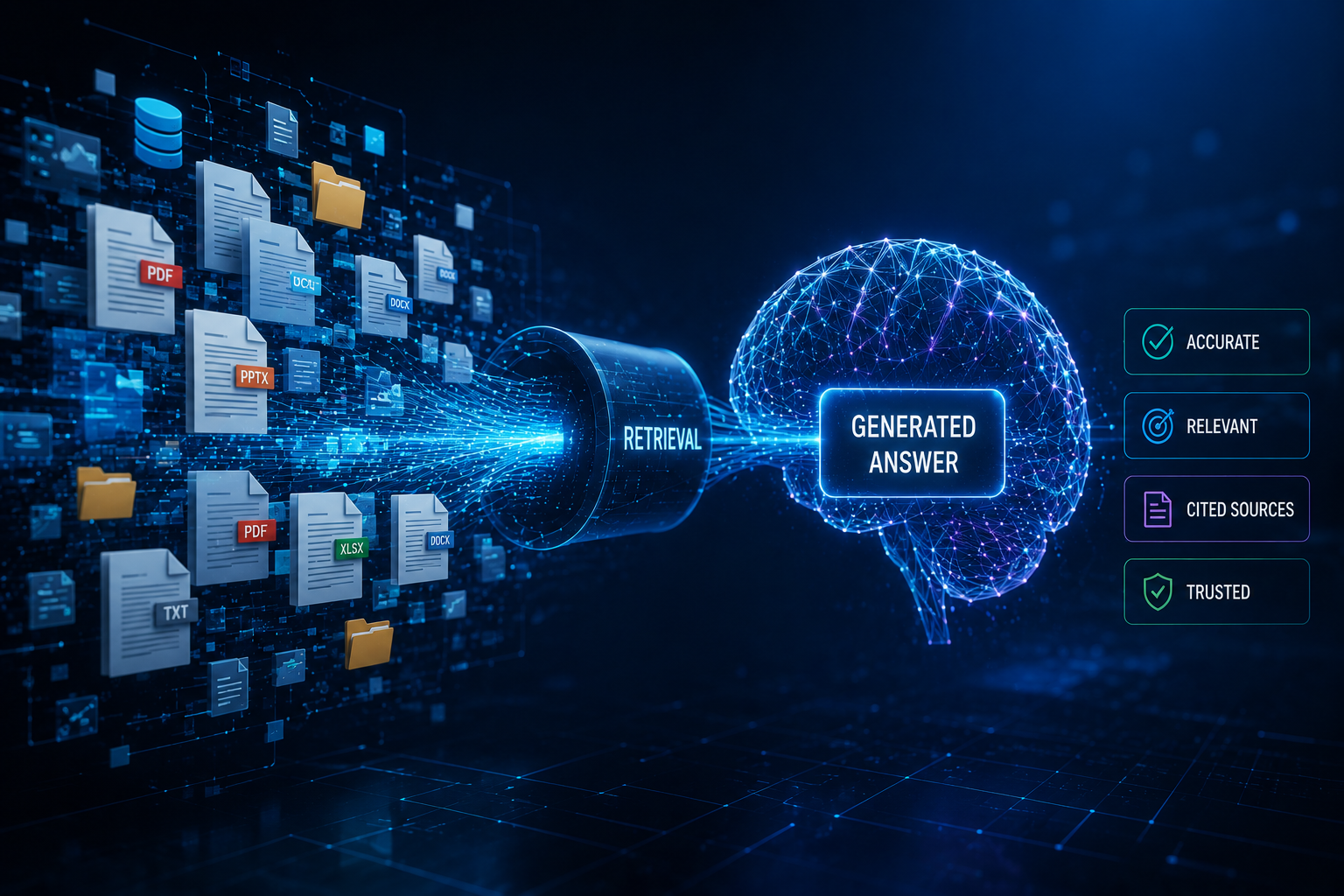
RAG Readiness: Why AI Answers Are Only as Strong as Your Knowledge Base
Retrieval-augmented generation can make AI more useful for business teams, but only when the underlying documents, permissions, metadata, and review process are ready for operational use.

Summary
RAG connects an AI assistant to approved business knowledge so employees can retrieve relevant information before generating an answer. The technology can improve consistency and access to knowledge, but it also exposes weaknesses in document quality, source ownership, outdated files, access permissions, and review standards. RAG readiness means preparing the knowledge environment before asking AI to answer business questions.
Key Highlights
Audit source content
Remove outdated, duplicate, and conflicting documents before they become part of AI-generated answers.
Define source authority
Clarify which documents are official, who owns them, and how updates are approved.
Respect permissions
AI retrieval should not expose information employees would not normally be allowed to access.
Use metadata carefully
Dates, departments, document type, and status can help the system retrieve the right source.
Measure answer quality
Track whether AI responses are complete, accurate, grounded, and useful for the workflow.
Keep humans accountable
RAG can support faster answers, but business owners still need to verify critical outputs.
Many organizations want an AI assistant that can answer questions from internal knowledge. The promise is attractive: employees find policies faster, sales teams prepare with better context, service teams locate approved procedures, and managers reduce time spent searching for documents.
The technical term often used for this pattern is retrieval-augmented generation, or RAG. In practical business language, it means the AI system retrieves relevant content from approved sources before generating a response.
The challenge is that retrieval does not fix a weak knowledge base. If the documents are outdated, duplicated, poorly organized, or unclear, the AI assistant may simply make those problems easier to distribute.
Make your knowledge base ready for AI-assisted work
WSI AI Advisors helps organizations evaluate document quality, workflow fit, governance needs, and practical implementation steps before building AI assistants around business knowledge.
RAG Is Not a Shortcut Around Knowledge Management
A RAG system depends on the material it can retrieve. That material may include policies, standard operating procedures, service guides, product documentation, proposals, FAQs, internal playbooks, or training content.
If employees currently struggle to find the right document, they may also struggle to trust an AI assistant built on the same content. A reliable AI knowledge workflow starts with a reliable knowledge environment.
The organization should know which files are current, which documents are archived, which sources are approved, and which teams own each content area.
Start With the Questions Employees Actually Ask
A useful RAG project should begin with real questions. What does the support team search for every week? Which policies generate repeated clarification requests? Which procedures slow down onboarding? Which documents are hard to interpret under time pressure?
Collecting actual questions prevents the project from becoming a broad document-indexing exercise with no operational target. It also helps the team evaluate whether the AI response is good enough for the task.
For each question type, leaders should identify the approved source, the acceptable answer format, the level of confidence required, and whether a human review is needed.
RAG readiness starts with the business question, not the technical architecture.
When the question is clear, the organization can decide which sources, permissions, and review standards are needed to answer it responsibly.
A Technical Readiness Checklist for Business Leaders
Business leaders do not need to design the full technical architecture, but they do need to understand the operational requirements. A RAG assistant is not just a chatbot attached to a folder. It is a workflow that retrieves, interprets, and presents information to employees.
The readiness checklist should cover source quality, access control, document chunking, metadata, response review, logging, and update procedures. Each area affects whether the assistant can be trusted inside daily operations.
The most important question is not whether the system can produce an answer. The important question is whether the organization can explain where that answer came from and when it should be trusted.
Readiness signals
- Documents have clear owners and review dates
- Outdated files are archived or removed
- Permissions match normal business access
- AI responses can show source references
- Teams have test questions and review criteria
Implementation risks
- The assistant retrieves old or conflicting guidance
- Employees receive information outside their role
- Answers sound confident but are not grounded
- Source updates are not reflected in the system
- No one owns answer quality after launch
A Practical 60-Day RAG Readiness Sprint
A company does not need to prepare every document before beginning. A focused sprint around one high-value knowledge area can reveal the maturity of the content, permissions, and workflow.
The goal is to prove whether the organization can support reliable AI-assisted retrieval in a contained business process.
Three phases to prepare
Days 1–15
Question and source mapping
Collect recurring employee questions and identify the approved documents needed to answer them.
Days 16–40
Content cleanup and controls
Remove duplicates, confirm owners, add metadata, validate permissions, and create response standards.
Days 41–60
Testing and adoption design
Run test questions, review answer quality, train users, and decide whether to expand the use case.
Source Citations Are a Business Control
For many business workflows, the AI answer should not be accepted on its own. Employees need a way to see the source behind the response, especially when the answer affects a customer, employee, vendor, or financial decision.
Source references help users verify the answer, identify outdated information, and learn which documents are authoritative. They also create a feedback loop for improving the knowledge base.
This does not mean every internal AI answer needs a formal citation. It means that higher-risk workflows should make the source visible enough for human judgment.
Questions for RAG quality review
- Did the assistant retrieve the correct source?
- Was the answer complete enough for the employee’s task?
- Did the response include outdated or conflicting information?
- Could the user see where the answer came from?
- Did the answer require escalation to a subject matter expert?
How WSI AI Advisors Helps
WSI AI Advisors helps organizations evaluate whether their knowledge environment is ready for AI-supported retrieval. That may include use case selection, document readiness review, workflow design, governance standards, training, and implementation planning.
The goal is to help the business improve access to knowledge without creating a system that spreads unreliable or poorly controlled information.
The strongest AI programs stay practical.
They connect strategy, governance, workflow design, training, and measurement in a way the organization can actually maintain.
FAQs: RAG Readiness
Ready to make business knowledge easier to use?
Begin with one workflow, one set of approved sources, and a practical review process that keeps AI answers grounded.
Book an AI Strategy CallEmbrace Digital. Stay Human.