

 604.506.5068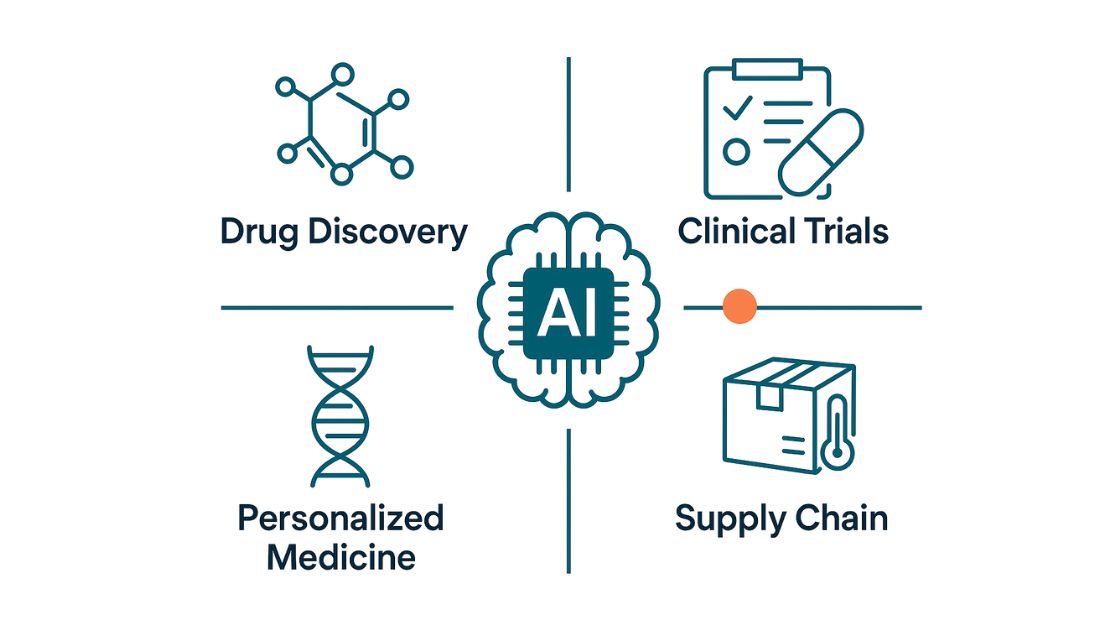
Continue reading "AI in Pharma: From Hype to High-Impact Results"
Artificial intelligence is no longer an R-&-D side project for the pharmaceutical sector. Between 2025 and 2030, industry investment in AI is projected to jump six-fold—from US $4 billion to US $25 billion—because early adopters are already seeing cycle-time reductions, cost savings, and new revenue streams.pharmexec.com Below are four proven use cases that illustrate how AI is moving the needle today—and why every pharma leader should be building an AI roadmap.

1. Accelerating Drug Discovery
Core technology: deep‐learning generative models + protein-structure prediction
Business problem: Traditional hit-to-lead campaigns require screening millions of compounds over 5–7 years, at a cost that often exceeds US $2.6 billion per approved drug.
What’s working:
-
Insilico Medicine’s ISM001-055 for idiopathic pulmonary fibrosis went from first concept to Phase II readiness in just 24 months, using generative adversarial networks (GANs) to design novel molecules targeted to a previously “undruggable” protein.thetimes.co.uk
-
DeepMind’s AlphaFold2 and its open structural database now allow chemists to model binding pockets for 200 million proteins in silico, trimming months of wet-lab experimentation.lifebit.ai
Benefits realized:
-
60–70 % reduction in early-stage discovery timelines
-
Double-digit improvement in hit-to-lead success rates
-
Potential savings of US $300–500 million per asset entering clinical development
2. Smarter, Adaptive Clinical Trials
Core technology: reinforcement learning + advanced analytics platforms
Business problem: One in three Phase III trials fails for avoidable reasons such as poor patient matching, sub-optimal dosing, or protocol amendments that balloon costs.
What’s working:
-
TrialTranslator, launched in January 2025, ingests real-time patient-level data and uses reinforcement learning to continuously adjust cohort stratification and dose schedules, boosting statistical power without expanding enrollment.appliedclinicaltrialsonline.comcoherentsolutions.com
-
AI-driven eligibility engines now mine EHR and omics data to pre-qualify patients, cutting screen-fail rates by up to 30 %.reprocell.com
Benefits realized:
-
10–15 % reduction in trial duration
-
20–40 % cost savings on monitoring and protocol amendments
-
Higher probability of technical and regulatory success (PTRS) due to cleaner, more diverse data sets
3. Personalized (Precision) Medicine at Scale
Core technology: multimodal machine learning on genomics, imaging, and longitudinal health records
Business problem: “One-size-fits-all” therapies underperform in heterogeneous patient populations, leading to variable efficacy and adverse events.
What’s working:
-
Oncology pipelines now pair AI-powered variant calling with digital twin simulations to predict individual tumor response—informing adaptive dosing regimens in days, not weeks.estenda.com
-
AI-guided clinical decision support tools integrate real-world evidence with genomic biomarkers, enabling label-expansion strategies for existing molecules while improving patient outcomes.iotworldmagazine.com
Benefits realized:
-
Up to 50 % increase in responder rates in early oncology studies
-
Reduction in serious adverse events by identifying high-risk subgroups before treatment
-
New revenue channels through targeted companion diagnostics
4. Resilient, Data-Driven Supply Chains
Core technology: predictive machine learning + IoT sensor analytics
Business problem: Biologics and vaccines demand cold-chain compliance; over- or under-producing inventory can result in write-offs or drug shortages.
What’s working:
-
According to LogiPharma 2024, 40 % of pharma companies now deploy AI demand-forecasting models that factor in epidemiological data, social-media signals, and weather patterns to predict SKU-level demand 8–12 weeks out.eawlogistics.comblog.paxafe.com
-
Edge AI monitors temperature-controlled shipments in real time, triggering automated rerouting when excursions are predicted—protecting product integrity and improving service levels.
Benefits realized:
-
15–25 % reduction in inventory carrying costs
-
Up to 70 % fewer temperature excursions in transit
-
Faster response to regional demand spikes, safeguarding patient access and brand reputation
Looking Ahead: The Next Wave
Generative multimodal AI, federated learning on privacy-preserving data meshes, and real-time “lab-in-the-loop” automation are set to push these gains even further. Regulatory bodies are moving quickly: both the EMA and FDA are piloting AI sandboxes to streamline algorithm validation, while the WHO is finalizing guidance on trustworthy health-AI deployment. For pharma and biotech innovators, the window to capture first-mover advantage is now.
Whether you oversee R-&-D, clinical operations, or commercial supply, start by mapping a single high-value use case, assembling a cross-functional data team, and running a focused pilot with clear success metrics. The organizations that treat AI as a strategic capability—rather than a tech experiment—will define the next decade of biopharma leadership.
About the Author
The Best Digital Marketing Insight and Advice
The WSI Digital Marketing Blog is your go-to-place to get tips, tricks and best practices on all things digital
marketing related. Check out our latest posts.
Ready to turn AI insight into a practical business plan?
Speak with an AI ConsultantWe are committed to protecting your privacy. For more info, please review our Privacy and Cookie Policies. You may unsubscribe at any time.
Don't stop the learning now!

Beyond AI Workshops: How to Turn Employee Training Into Real Business Results
AI workshops can generate enthusiasm overnight. Turning that enthusiasm into better business performance takes something more deliberate: a clear problem to solve, a dependable process, and managers who know what success should look like. For organizations investing in artificial intelligence, the important question is no longer simply, “Have our employees learned to use AI?” It …
Continue reading “Beyond AI Workshops: How to Turn Employee Training Into Real Business Results”
READ MORE
AI Training Should Improve Work, Not Just Tool Familiarity
Investing in AI training is becoming a priority for businesses that want to work more efficiently, improve customer experiences, and prepare their teams for a changing workplace. But completing an AI training session does not automatically mean employees are ready to use AI well in their day-to-day work. A team may learn how to generate …
Continue reading “AI Training Should Improve Work, Not Just Tool Familiarity”
READ MORE
Responsible AI in Banking: A Practical Strategy for Secure AI Adoption
Artificial intelligence is creating new opportunities for banks and financial institutions to improve operations, reduce repetitive tasks, and support employees in their daily work. However, adopting AI in financial services requires more than selecting the right software. Banks operate in environments where data protection, regulatory requirements, cybersecurity, and customer trust are essential. The challenge is …
Continue reading “Responsible AI in Banking: A Practical Strategy for Secure AI Adoption”
READ MORE