

 604.506.5068
AI
Beyond AI Workshops: How to Turn Employee Training Into Real Business Results

Continue reading "Beyond AI Workshops: How to Turn Employee Training Into Real Business Results"
AI workshops can generate enthusiasm overnight. Turning that enthusiasm into better business performance takes something more deliberate: a clear problem to solve, a dependable process, and managers who know what success should look like.
For organizations investing in artificial intelligence, the important question is no longer simply, “Have our employees learned to use AI?” It is, “What can our teams now do better, faster, or more consistently?”
That shift changes how businesses design training, support employees, and measure progress. Instead of treating AI as another software skill, forward-thinking organizations connect it to real work, clear responsibilities, and measurable outcomes.
The opportunity is not just to create a workforce that understands AI. It is to build teams that can use it thoughtfully, consistently, and productively.
Key Highlights
- Start with the business outcome: Effective AI training should address a specific operational need, not simply introduce new technology.
- Make learning role-specific: Employees need practical examples that reflect their responsibilities and working conditions.
- Give managers a clear role: Leaders help establish quality standards, accountability, and expectations for AI-assisted work.
- Measure the complete workflow: Faster generation does not necessarily mean better performance if review and correction requirements increase.
- Support adoption beyond the workshop: Ongoing coaching and workflow improvements help turn isolated experimentation into consistent practice.
AI training becomes a business investment when employees can demonstrate better results, not simply greater familiarity with technology.
The Missing Connection Between AI Training and Business Performance
Businesses have more opportunities than ever to introduce employees to artificial intelligence. Online courses, internal workshops, software demonstrations, and self-directed learning can help people become comfortable with unfamiliar tools.
But increased familiarity does not guarantee improved performance.
Consider a marketing department that learns to use AI for content development. Employees may quickly generate campaign ideas, outlines, and first drafts. Yet if those materials consistently require substantial revisions, the organization may not see the efficiency improvements it expected.
The same challenge can appear in customer service, sales, administration, and operations. AI may accelerate individual activities without improving the complete process.
This happens because workplace performance depends on more than technical ability. It also requires reliable information, established procedures, appropriate judgment, collaboration, and quality control.
Successful AI training needs to address the interaction between these elements.
Why AI Training Should Begin With a Business Problem
Before selecting an AI training program, organizations should identify where improvements are needed and what successful change would look like.
For example, a business might want to reduce the time required to prepare recurring reports, improve customer response consistency, accelerate internal research, or make better use of existing information.
Each objective suggests a different training approach.
- Marketing: Develop stronger content briefs, organize research, and improve consistency across campaigns.
- Sales: Prepare prospect research, organize follow-up information, and improve routine administrative workflows.
- Operations: Summarize recurring information, standardize documentation, and reduce repetitive tasks.
- Customer service: Support response preparation using approved information and established communication guidelines.
- Management: Organize meeting outcomes, review reports, and support planning and internal communication.
Instead of teaching every department the same set of generic prompts, organizations can focus on the skills that support each team’s actual responsibilities.
This creates a stronger connection between employee learning and business value.
Four Capabilities Employees Need Beyond Basic AI Skills
Learning how to interact with AI applications is an important first step. However, dependable business use requires several complementary capabilities.
1. Understanding the Workflow Before Using AI
Employees need to understand the purpose of a task before deciding how artificial intelligence should support it.
That includes identifying required inputs, expected outputs, relevant quality standards, and any approval requirements.
For example, using AI to prepare a customer communication requires more than generating a polished message. The employee must understand the customer’s situation, the organization’s policies, and the appropriate response.
AI should support the process rather than determine it.
2. Evaluating Accuracy and Reliability
AI-generated information can appear complete and convincing even when it contains errors, omissions, or unsupported conclusions.
Employees should learn how to check important facts, identify missing information, recognize uncertainty, and compare outputs with trusted business sources.
The appropriate level of verification will vary depending on the task. A brainstorming exercise carries different consequences from financial reporting, sensitive customer communications, or operational recommendations.
Training should help employees understand those differences and respond appropriately.
3. Working Within Clear Information Boundaries
Responsible AI use requires employees to know which tools are approved, what information may be entered, and which activities require additional safeguards.
Organizations should establish understandable guidelines for confidential information, customer data, internal documents, and business-sensitive material.
Practical training should include realistic scenarios so employees can recognize potential concerns before they occur.
4. Knowing When Human Judgment Is Essential
Artificial intelligence can support analysis, preparation, organization, and repetitive activities. However, responsibility for business decisions cannot simply be transferred to a technology tool.
Employees need to understand when to question an output, request clarification, escalate an issue, or make an independent decision.
The objective is to develop professionals who can work effectively with AI while maintaining accountability for their responsibilities.
Why Managers Determine Whether AI Training Sticks
Employees may discover useful AI applications independently, but managers influence whether those practices become part of normal operations.
Managers help translate organizational priorities into everyday expectations. They can identify appropriate workflows, define standards, provide feedback, and monitor whether changes are producing the intended results.
Importantly, managers do not need to master every AI application. They need sufficient understanding to evaluate opportunities, recognize limitations, and guide their teams responsibly.
Several management practices are particularly valuable:
- Establish clear objectives: Explain why AI is being introduced and what the team is expected to improve.
- Define responsibilities: Clarify who prepares, verifies, approves, and owns AI-assisted work.
- Encourage appropriate experimentation: Allow employees to explore useful applications within established boundaries.
- Review performance: Evaluate quality, efficiency, and operational impact rather than focusing only on how frequently tools are used.
- Provide feedback: Help employees improve their processes and develop confidence through practical experience.
Consistent managerial support makes it easier for teams to move from occasional AI use to structured, repeatable practices.
From Tool Knowledge to Operational Capability
The distinction between learning AI tools and building an AI-capable organization becomes clearer when comparing the two approaches.
| Tool-Focused AI Learning | Business-Focused AI Capability |
|---|---|
| Employees learn features and prompts. | Employees learn how to improve defined workflows. |
| Training examples are generic. | Practice reflects actual job responsibilities. |
| Success is measured through participation. | Success is measured through operational outcomes. |
| Output generation is emphasized. | Accuracy, verification, and quality are included. |
| Individuals establish their own methods. | Teams follow shared expectations and safeguards. |
| Learning ends after the session. | Coaching and process improvement continue. |
Tool knowledge creates possibilities. Operational capability determines whether those possibilities translate into meaningful business improvements.
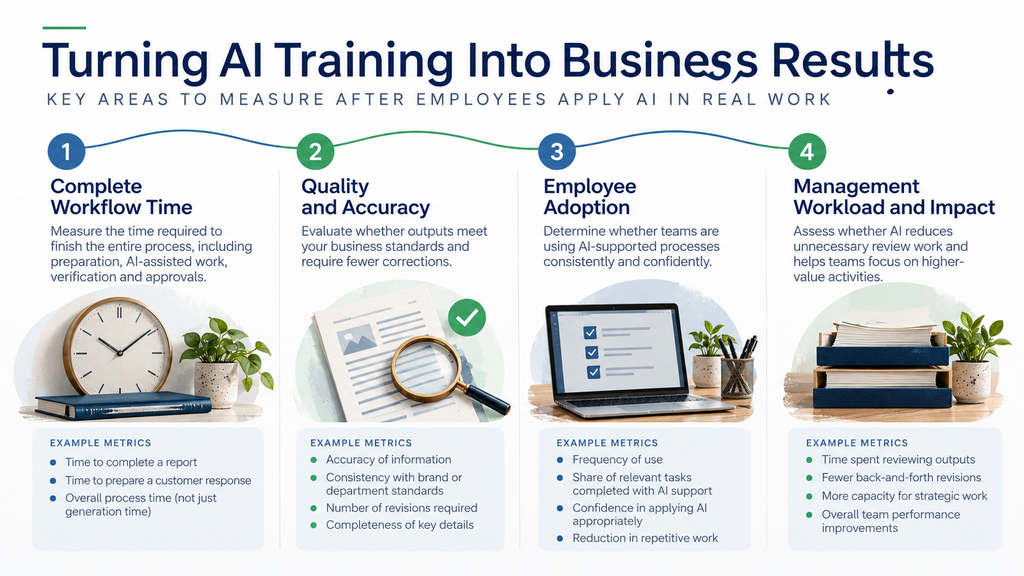
How to Evaluate Whether AI Training Is Working
Training attendance and employee satisfaction provide useful feedback, but they reveal little about whether business performance has improved.
Organizations should evaluate outcomes after employees begin applying AI in normal working conditions.
Complete Workflow Time
Measure how long the entire activity takes, including preparation, AI-assisted work, verification, revisions, and approvals. An improvement in one step may not translate into an improvement across the complete process.
Output Quality
Compare results against established business standards. Useful indicators include accuracy, consistency, missing information, and the number of corrections required.
Employee Adoption
Evaluate whether employees can apply approved AI-supported processes consistently without excessive supervision or technical assistance.
Management Review Effort
Determine whether the new process reduces unnecessary managerial work or creates additional responsibilities for reviewing and correcting outputs.
Business Capacity
Consider whether teams can handle greater workloads, respond more consistently, or redirect time toward higher-value activities without compromising quality.
The most useful measure of AI training is the improvement it creates in the work employees perform every day.
A Four-Week Approach to Building Practical AI Capability
Organizations can begin building practical AI capabilities without launching an enterprise-wide transformation.
A focused pilot allows leadership to test assumptions, understand operational challenges, and make informed decisions about broader adoption.
Week 1: Select a High-Value Workflow
Identify a recurring activity affected by delays, repetitive work, or inconsistent quality. Document how the process currently operates and establish baseline measures.
Choose a workflow with a clear owner, manageable risks, and an outcome that can be evaluated.
Week 2: Build Relevant Skills and Standards
Provide targeted training using approved tools and realistic examples. Establish expectations for information handling, output quality, verification, and human review.
Make sure employees understand both the capabilities of AI and the limitations that apply to the selected activity.
Week 3: Apply AI in Normal Working Conditions
Introduce the AI-supported workflow with appropriate oversight. Encourage employees to document challenges, unexpected results, correction requirements, and opportunities for improvement.
Managers should provide feedback while allowing employees to develop practical confidence.
Week 4: Review Results and Refine the Process
Compare performance with the original baseline. Evaluate changes in completion time, quality, adoption, and review effort.
Use the findings to determine whether the workflow needs further refinement, additional training, or broader implementation.
Even a small pilot can reveal valuable lessons about how technology, people, and processes need to work together.
Building a Culture of Responsible AI Improvement
Long-term AI adoption requires more than selecting useful technologies. Employees need an environment where learning, responsible experimentation, and continuous improvement are supported.
Organizations can encourage this culture by creating opportunities to exchange successful examples, discuss limitations, and update established practices.
Regular coaching, shared resources, clear escalation procedures, and management involvement can make AI-supported workflows more reliable over time.
Importantly, responsible adoption does not mean avoiding experimentation. It means creating the conditions for experimentation to deliver value without unnecessary risk.
As teams become more confident, organizations can expand successful approaches to other workflows while continuing to evaluate their effectiveness.
How WSI AI Advisors Helps Connect AI Training to Business Value
Many organizations recognize the potential of artificial intelligence but need support identifying where to begin, which applications deserve priority, and how to introduce change effectively.
WSI AI Advisors takes a practical, business-first approach to AI strategy and adoption.
Our approach helps organizations evaluate their readiness, review existing workflows, identify promising opportunities, and develop practical implementation plans.
Areas of support can include:
- AI readiness assessments and strategic planning
- Business workflow analysis and bottleneck identification
- AI use-case discovery and prioritization
- Responsible AI guidance and governance considerations
- Role-specific training and adoption planning
- Pilot development and performance evaluation
- Ongoing improvement and organizational capability development
The objective is to help businesses move beyond general AI awareness and identify practical opportunities to strengthen performance.
If your company has already invested in AI training but is unsure whether those skills are improving daily operations, a structured readiness and workflow review can provide a useful starting point.
Frequently Asked Questions
What is the difference between AI training and AI adoption?
AI training focuses on developing employee knowledge and skills. AI adoption involves integrating those capabilities into real business processes, establishing responsibilities, and evaluating whether the changes improve performance.
Why should AI training be connected to business workflows?
Workflow-based training helps employees understand how AI applies to their actual responsibilities. It also allows organizations to establish clear quality expectations, review requirements, and measures of success.
What role should managers play in AI adoption?
Managers should help identify suitable applications, clarify expectations, establish accountability, provide feedback, and evaluate whether AI-supported processes are producing useful business outcomes.
How can businesses measure the success of AI training?
Organizations can compare complete workflow time, output quality, correction requirements, employee adoption, and management review effort before and after introducing AI-supported processes.
Can small businesses benefit from structured AI training?
Yes. Small businesses can begin with a limited number of recurring workflows, provide targeted employee training, and evaluate results before expanding their use of AI.
Make AI Training a Driver of Business Performance
Artificial intelligence can support more efficient workflows, stronger information management, and better use of employee time. However, those benefits do not automatically follow from technology access or introductory training.
Organizations need to connect employee learning with real business objectives, clear quality standards, appropriate human oversight, and continuous improvement.
Managers are essential to that process because they translate strategy into daily expectations and help teams develop reliable working practices.
When AI training is designed around business outcomes, organizations can move beyond learning new tools and begin building lasting operational capability.
About the Author
The Best Digital Marketing Insight and Advice
The WSI Digital Marketing Blog is your go-to-place to get tips, tricks and best practices on all things digital
marketing related. Check out our latest posts.
Ready to turn AI insight into a practical business plan?
Speak with an AI ConsultantWe are committed to protecting your privacy. For more info, please review our Privacy and Cookie Policies. You may unsubscribe at any time.
Don't stop the learning now!

AI Training Should Improve Work, Not Just Tool Familiarity
Investing in AI training is becoming a priority for businesses that want to work more efficiently, improve customer experiences, and prepare their teams for a changing workplace. But completing an AI training session does not automatically mean employees are ready to use AI well in their day-to-day work. A team may learn how to generate …
Continue reading “AI Training Should Improve Work, Not Just Tool Familiarity”
READ MORE
Responsible AI in Banking: A Practical Strategy for Secure AI Adoption
Artificial intelligence is creating new opportunities for banks and financial institutions to improve operations, reduce repetitive tasks, and support employees in their daily work. However, adopting AI in financial services requires more than selecting the right software. Banks operate in environments where data protection, regulatory requirements, cybersecurity, and customer trust are essential. The challenge is …
Continue reading “Responsible AI in Banking: A Practical Strategy for Secure AI Adoption”
READ MORE
Small businesses do not need to begin AI adoption with a company-wide rollout, a long list of tools, or a vague mandate to “use AI more.” They need one workflow that is already creating friction—and a disciplined way to test whether AI improves it. That is what a 30-day workflow test is for. The goal …
READ MORE