

 604.506.5068
Continue reading "AI Training Should Improve Work, Not Just Tool Familiarity"
Investing in AI training is becoming a priority for businesses that want to work more efficiently, improve customer experiences, and prepare their teams for a changing workplace.
But completing an AI training session does not automatically mean employees are ready to use AI well in their day-to-day work.
A team may learn how to generate content, summarize information, or use an AI assistant. The real test comes when those capabilities must fit existing processes, quality standards, information-handling rules, and approval procedures.
That is where effective AI training begins to look different from traditional technology education.
The goal is not to teach the most tools. It is to help people apply the right capabilities to the right work—with clear expectations, appropriate human review, and measurable business value.
The value of AI training is not measured by how many tools employees learn. It is measured by how effectively they use AI to improve work.
Why Traditional AI Training Often Falls Short
Many businesses introduce AI through workshops, webinars, demonstrations, or introductory courses. These are useful starting points: they build awareness and reduce hesitation.
But learning what an AI application can do is different from learning how to use it inside a reliable business process.
Consider an employee who learns to draft a customer email with AI. In a demonstration, the task may take seconds. In real work, the employee still needs to confirm the facts, reflect the customer’s request, follow communication standards, protect sensitive information, and obtain approval when required.
If training does not address those steps, the organization may create drafts faster without improving the complete workflow.
Common gaps include:
- Limited practical application: Employees understand demonstrations but struggle to apply them to their own work.
- Inconsistent quality: Outputs vary because teams lack shared standards.
- More review work: Managers spend time correcting AI-generated material instead of reducing bottlenecks.
- Unclear accountability: Employees do not know when AI is appropriate—or when human judgment must decide.
- Weak adoption: Teams return to old habits after the session.
- Unmeasured results: Leadership cannot tell whether the investment improved performance.
These are not simply training problems. They are operating-model problems.
Start With the Business Goal, Not the AI Tool
Before designing an AI training program, identify the business improvement you want to achieve.
The goal may be faster customer response times, less administrative work, more consistent reporting, stronger content development, or easier access to approved information. That goal should determine the workflow, the tools, the learning experience, and the measures of success.
For example:
- Marketing teams: Improve research, content planning, and first drafts while protecting brand consistency.
- Sales teams: Prepare prospect research, draft follow-ups, and organize CRM information.
- Operations teams: Summarize recurring reports, organize documentation, and reduce repetitive administration.
- Customer service teams: Prepare response drafts and retrieve approved information more efficiently.
- Management teams: Organize meeting notes, create action summaries, and prepare structured internal reports.
Each use case should be assessed for accuracy requirements, information security, human review, workflow fit, and expected impact.
This makes training more relevant because employees can see where AI fits—and where it does not.
Five Elements of Effective AI Training
1. Training Built Around Real Workflows
Employees learn faster when training reflects the work they actually do.
Instead of giving every department the same generic examples, build learning around role-specific workflows. A marketing employee might practice creating a campaign brief. An operations employee might work through a recurring internal report.
For every workflow, define:
- The business activity being improved
- The approved AI tools and information sources
- The role AI will play
- The expected output and quality standard
- The required human review
- The measure of improvement
That connection turns training from a one-time event into an implementation step.
2. Skills for Evaluating AI Outputs
Prompting matters, but it is only one part of responsible AI use.
Employees also need to evaluate what AI produces. A report can be well organized and still contain inaccurate information. A customer response can sound polished while missing essential context. A marketing draft can be grammatically correct but fail to reflect the company’s positioning.
Training should help employees recognize:
- Information that needs verification
- Incomplete or unsupported claims
- Inconsistent terminology or formatting
- Privacy and confidentiality concerns
- Outputs that do not meet business requirements
- Situations where a person must make the final decision
The objective is not simply to generate more material. It is to turn AI output into reliable work.
Employees who can evaluate AI-generated work are better positioned to create dependable business results.
3. Shared Processes and Quality Standards
When employees use AI without common guidelines, teams often develop inconsistent approaches to similar tasks.
One person may produce a detailed report; another may omit critical information. One may verify outputs carefully; another may rely too heavily on the first response.
Practical standards reduce unnecessary variation. Useful resources include:
- Approved prompt examples for recurring tasks
- Templates for common documents and communications
- Quality-review checklists
- Data-use guidelines
- Escalation procedures for questionable outputs
- Clear workflow responsibilities
Standardization should support professional judgment, not replace it. Templates make routine work more consistent; people still need discretion for complex situations, customer needs, and decisions that require experience.
4. Hands-On Practice and Meaningful Feedback
Confidence grows when employees practice AI-assisted tasks using realistic business scenarios.
Training exercises should include the conditions people face in normal operations: incomplete information, competing priorities, quality requirements, and approval steps.
For example, instead of asking employees to produce a generic marketing email, ask them to prepare one using an approved customer profile, brand guidelines, and a defined review process.
Then evaluate the result against the organization’s real expectations.
Feedback helps employees understand not only how to use AI, but how to adjust their approach and recognize a successful result.
5. Ongoing Support That Reinforces Adoption
A single training session can create interest. It rarely creates sustained adoption on its own.
AI tools, business processes, and risk requirements change. Teams need a way to ask questions, share lessons, update procedures, and improve the workflows that matter most.
Useful support mechanisms include:
- Short follow-up sessions
- Department-level AI champions
- Regular workflow reviews
- Updated templates and training resources
- Shared examples of successful use cases
- Manager coaching and feedback
This is how isolated experimentation becomes repeatable business practice.
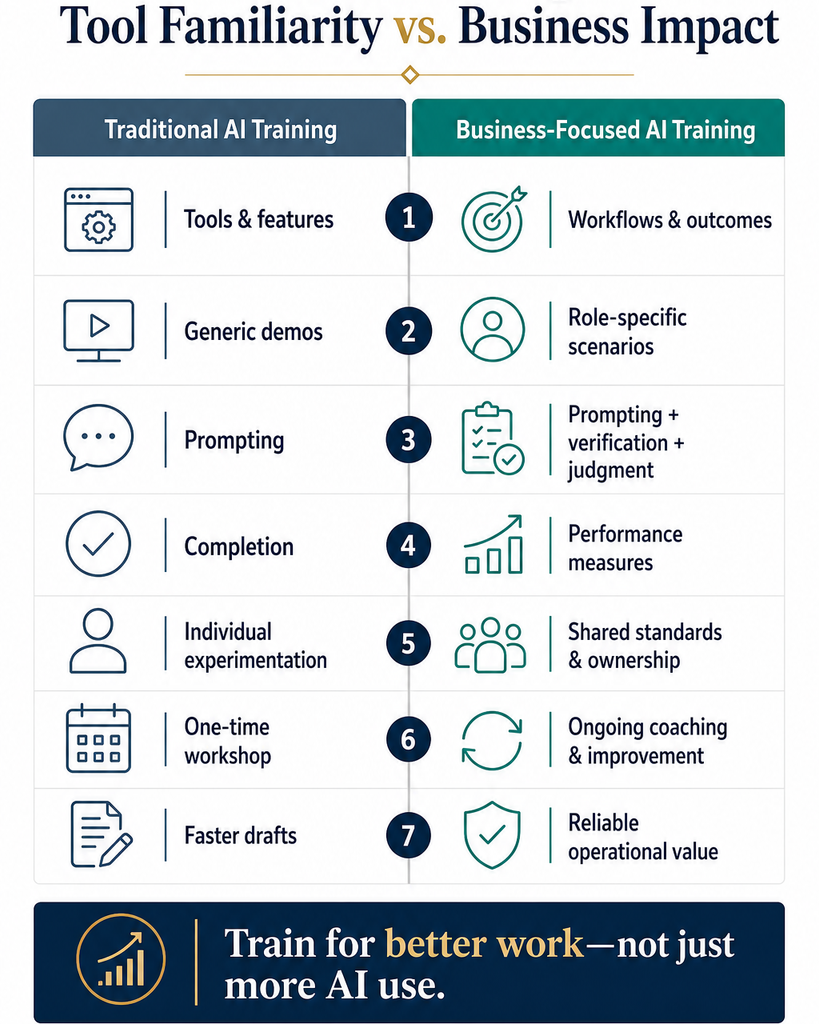
Traditional AI Training vs. Business-Focused AI Training
| Traditional AI Training | Business-Focused AI Training |
|---|---|
| Introduces tools and features | Connects AI capabilities to business workflows |
| Uses generic demonstrations | Uses examples from employees’ actual responsibilities |
| Focuses mainly on prompting | Builds prompting, verification, and decision-making skills |
| Measures attendance and completion | Evaluates workflow performance and business outcomes |
| Leaves implementation to individuals | Defines shared standards and responsibilities |
| Often ends after the workshop | Includes support and continuous improvement |
| Encourages experimentation | Connects experimentation to operational value |
Both approaches can build awareness. But lasting improvement requires a clear link between employee learning and how work gets done.
How to Measure the Business Impact of AI Training
Attendance, course completion, and positive feedback can show whether people participated. They do not show whether operations improved.
Measure what happens after employees begin using AI in real work.
Operational Efficiency
Compare the full workflow before and after training—not just AI generation time. Include preparation, review, corrections, and approvals.
Quality and Accuracy
Assess whether work meets established standards. Track errors, missing information, consistency, and revision volume.
Employee Adoption
Review whether employees continue using approved AI-assisted workflows and can apply them without constant support.
Management and Review Requirements
Determine whether AI reduces unnecessary supervisory work or creates more correction and approval effort.
Business Capacity
Assess whether teams can handle more appropriate work without sacrificing quality, increasing operational risk, or overloading employees.
A meaningful AI training outcome is a workflow that becomes more efficient, consistent, or reliable while maintaining the right level of human oversight.
A 30-Day Plan to Turn AI Training Into Business Results
You do not need to redesign every training program at once. Start with one workflow and learn from it.
Week 1: Select the Right Workflow
Choose one recurring activity with delays, repetitive work, or inconsistent results. Document the current process, assign an owner, and establish a baseline for time, quality, and review effort.
Week 2: Deliver Targeted Training
Train a small group using approved AI tools and scenarios directly related to the selected workflow. Cover quality expectations, information-handling boundaries, and human review requirements.
Week 3: Apply Skills to Real Work
Use the AI-assisted process in normal operating conditions with appropriate oversight. Capture observations about accuracy, completion time, corrections, employee confidence, and friction points.
Week 4: Review and Improve
Compare results with the baseline. Identify what worked, what needs adjustment, and whether the workflow is ready for wider adoption.
Use the findings to improve training materials, workflow instructions, and the next use case you prioritize.
This approach treats AI training as part of a business decision—not a standalone learning activity.
Why Leadership Matters
Employees cannot be expected to adopt AI consistently if leaders have not established priorities, responsibilities, and standards.
Leadership determines which workflows deserve attention, what success looks like, and how new processes will be supported.
Managers should help teams answer:
- Why are we introducing AI into this process?
- What improvement do we expect?
- Which tools and information sources are approved?
- Who reviews the output?
- What should employees do when AI produces an unreliable answer?
- How will we know whether the new approach is working?
When leaders provide consistent guidance, teams are better positioned to build useful habits and use AI responsibly.
AI adoption becomes a shared organizational initiative rather than a collection of disconnected experiments.
How WSI AI Advisors Can Help
The most important AI decision is often not which tool to buy. It is where AI can improve work, what capabilities teams need, and how to introduce change without creating avoidable risk or rework.
WSI AI Advisors helps organizations take a practical, business-first approach to AI adoption. Support can include:
- AI readiness assessments
- Workflow reviews and bottleneck identification
- Use-case discovery and prioritization
- AI strategy and roadmap development
- Role- and workflow-based training planning
- Responsible AI guidance for review, accountability, and information handling
- Pilot planning and outcome evaluation
- Adoption planning for sustained internal capability
The objective is to move beyond general AI awareness and identify realistic opportunities for operational improvement.
If your organization is investing in AI education but is unsure whether those skills are translating into better business results, an AI readiness or workflow review is a practical place to start.
Frequently Asked Questions
What is AI training for business teams?
AI training for business teams helps employees apply AI to relevant workplace responsibilities. Effective programs cover practical tool use, output verification, workflow integration, responsible information handling, and performance expectations.
Why is role-based AI training important?
Different departments use information, tools, and workflows differently. Role-based training connects AI capabilities to actual responsibilities, reducing the gap between instruction and application.
How can businesses measure AI training effectiveness?
Compare workflow performance before and after training. Useful measures include total task time, output quality, revision frequency, employee adoption, and review requirements.
Is learning to write AI prompts enough?
No. Prompting is useful, but employees also need to verify important information, follow organizational policies, evaluate outputs, and know when human judgment must decide.
How often should businesses update AI training?
Review training as AI tools, business processes, security requirements, and employee responsibilities evolve. Periodic coaching, updated examples, and workflow reviews help keep capabilities useful.
What types of businesses can benefit from AI training?
Any organization can benefit when it identifies appropriate, well-governed use cases. Marketing, sales, operations, administration, customer service, and management teams often have workflows worth evaluating.
How can WSI AI Advisors help a company get started?
WSI AI Advisors can help evaluate AI readiness, review workflows, prioritize practical opportunities, and develop an adoption plan that connects employee capability with business priorities, responsible use, and measurable results.
Make AI Training an Investment in Business Performance
AI can help teams organize information, reduce repetitive work, and improve everyday operations. But those benefits do not come from tool access alone.
Organizations need clear objectives, role-specific learning, quality standards, practical application, and ongoing support.
By connecting AI training to real workflows, leaders can make better decisions about where AI creates value—and how teams can use it responsibly.
The goal is not simply to create an AI-trained workforce. It is to build a team that can use AI to deliver better business outcomes.
About the Author
The Best Digital Marketing Insight and Advice
The WSI Digital Marketing Blog is your go-to-place to get tips, tricks and best practices on all things digital
marketing related. Check out our latest posts.
Ready to turn AI insight into a practical business plan?
Speak with an AI ConsultantWe are committed to protecting your privacy. For more info, please review our Privacy and Cookie Policies. You may unsubscribe at any time.
Don't stop the learning now!

Responsible AI in Banking: A Practical Strategy for Secure AI Adoption
Artificial intelligence is creating new opportunities for banks and financial institutions to improve operations, reduce repetitive tasks, and support employees in their daily work. However, adopting AI in financial services requires more than selecting the right software. Banks operate in environments where data protection, regulatory requirements, cybersecurity, and customer trust are essential. The challenge is …
Continue reading “Responsible AI in Banking: A Practical Strategy for Secure AI Adoption”
READ MORE
Small businesses do not need to begin AI adoption with a company-wide rollout, a long list of tools, or a vague mandate to “use AI more.” They need one workflow that is already creating friction—and a disciplined way to test whether AI improves it. That is what a 30-day workflow test is for. The goal …
READ MORE
AI Ready or Just Experimenting With AI Tools? A Practical Way to Tell
Many businesses are already using AI. Someone is drafting with ChatGPT. A sales team is using AI to research prospects. Marketing is testing new content tools. Operations is looking for ways to reduce repetitive work. That activity can be useful. It can reveal where people see friction, where time is being lost, and where teams …
Continue reading “AI Ready or Just Experimenting With AI Tools? A Practical Way to Tell”
READ MORE