

 604.506.5068
AI
Practical AI Adoption: From Tool Experimentation to Business Capability

Continue reading "Practical AI Adoption: From Tool Experimentation to Business Capability"
AI is now easy to access. What remains difficult is deciding where it belongs in the business.
For many leadership teams, the problem is not a shortage of AI tools or ideas. It is the absence of a practical way to connect AI activity to a real workflow, a clear owner, appropriate guardrails, and a business outcome worth measuring.
That is why practical AI adoption should not begin with a tool-selection exercise. It should begin with an operating question:
Which part of the business would improve if people, processes, and AI worked together differently?
AI Adoption Is More Than Access to AI Tools
Giving a team access to AI can create useful experimentation. It can also create fragmented practices, inconsistent quality, unclear data handling, and a growing list of pilots with no shared definition of success.
Access is not adoption.
Adoption is the deliberate work of deciding where AI can create value, designing how it fits into the workflow, preparing people to use it responsibly, and measuring whether the change is worth expanding.
The unit of AI adoption is not the tool. It is the governed workflow.
A workflow-first approach changes the conversation. Instead of asking, “Which AI platform should we buy?” leaders can ask:
- Where are we losing time to repetitive work, slow handoffs, or avoidable rework?
- Which decisions would benefit from faster access to relevant information?
- Where can AI assist without removing human judgment or accountability?
- What outcome would make this initiative worth continuing?
Those questions create a stronger foundation for action than a broad mandate to “use AI more.”
Signs Your Organization Is Still in the Experimentation Stage
Many organizations believe they are adopting AI when they are actually accumulating isolated experiments.
That distinction matters because experimentation can create useful learning, but it does not automatically create a repeatable business capability.
Common signs that AI is still operating at the experimentation stage include:
- Teams are using different tools for similar tasks without shared standards.
- AI usage depends heavily on a small number of enthusiastic employees.
- Outputs are useful, but there is no consistent review process.
- No one clearly owns the outcome of the AI-enabled workflow.
- Success is described in terms of activity rather than business impact.
- Pilots continue without a clear decision to scale, refine, pause, or stop.
These conditions do not mean the organization is failing. They usually mean the experimentation phase has produced enough learning to justify a more structured operating model.
Start With Readiness, Not a Rushed Rollout
AI adoption touches more than technology. It affects people, processes, data, decision rights, policies, training, and the way quality is reviewed.
Before committing to a solution, organizations benefit from understanding their readiness across those areas. A readiness review can help leadership identify practical constraints, such as unclear process ownership, inconsistent data, limited internal capacity, missing governance expectations, or a lack of agreement on the business problem being solved.
This is not about waiting for perfect conditions. It is about choosing a starting point that fits the organization’s current reality.
A practical first initiative is often one with:
- A defined workflow problem
- A clear process owner
- A manageable scope
- Appropriate human review
- A realistic implementation path
- A measurable outcome
The goal is not to identify the most impressive AI use case. It is to identify the use case that can produce useful evidence for the next decision.
Prioritize Use Cases by Business Value and Feasibility
AI opportunities can appear everywhere: customer service, sales, marketing, operations, finance, reporting, knowledge management, and internal communications.
That abundance can become a problem. Without a way to compare opportunities, teams may pursue the loudest idea, the newest technology, or the easiest demonstration rather than the work that matters most.
A prioritized use-case backlog gives leadership a more disciplined way to decide. Each opportunity can be considered through questions such as:
- What business priority or workflow problem does it address?
- Who owns the process and the outcome?
- What information, systems, and people are involved?
- What risks or governance requirements need to be addressed?
- How difficult would it be to test?
- What result would indicate that the initiative should be refined, scaled, paused, or stopped?
This approach helps turn AI from a collection of ideas into a portfolio of decisions.
It also creates permission to say no. Not every use case deserves investment. Some are too complex, too risky, too dependent on missing data, or simply not important enough to justify the effort today.
Design the Human-AI Operating Pattern
AI creates value when it is embedded into work with clear inputs, review points, escalation paths, accountability, and outcome measures.
That means every initiative should clarify the role of both people and technology.
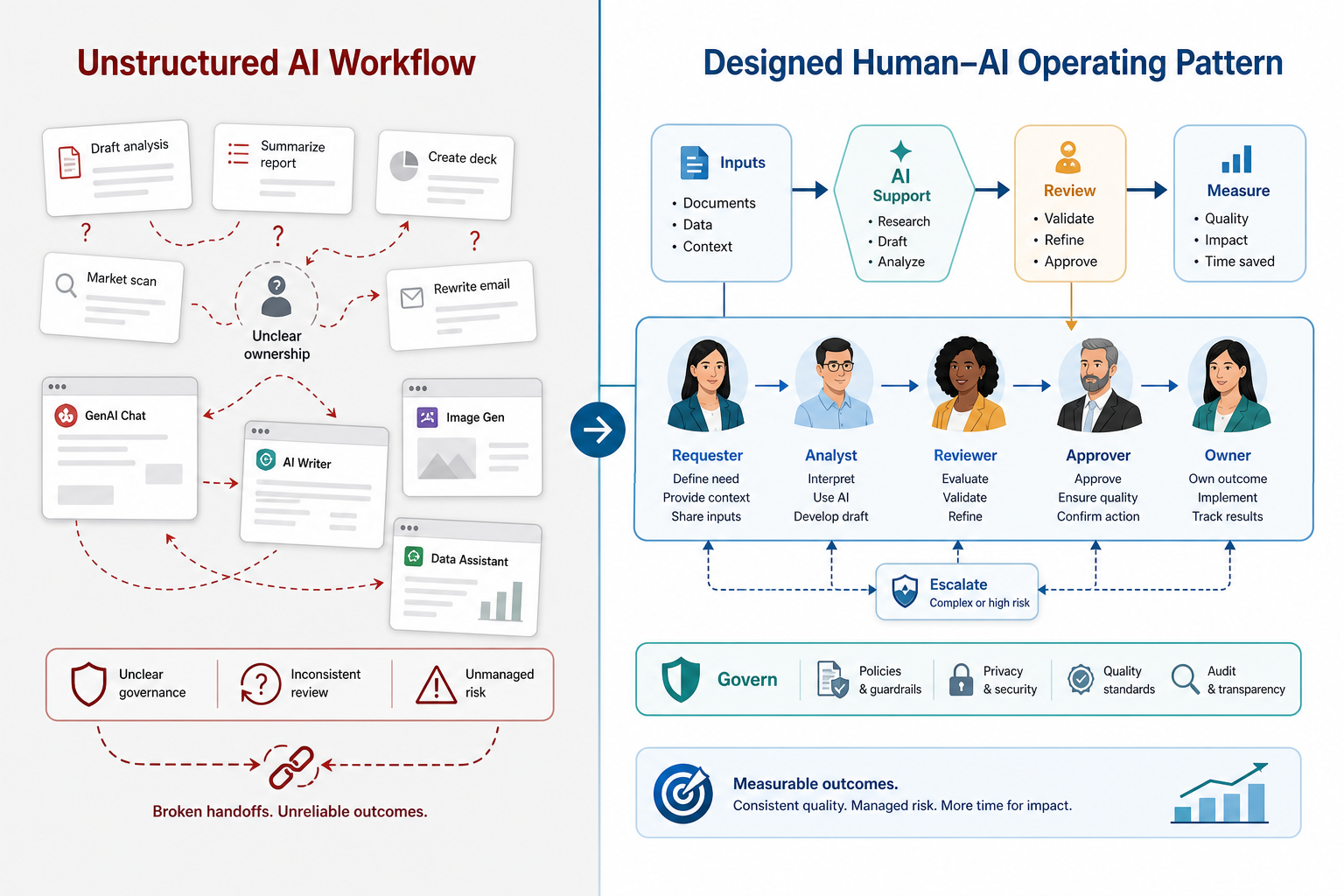
For example, AI may help summarize information, draft a first response, identify patterns, prepare a report, or support a decision. But teams still need to define who reviews the output, what quality standard applies, when an exception should be escalated, and what information should not be used in the process.
Governance is not a separate layer that appears after implementation. It is part of workflow design.
Governance can clarify acceptable use, accountability, information handling, review requirements, and the boundaries within which teams can work with confidence.
When those expectations are unclear, people either avoid useful tools or use them inconsistently. When they are clear, teams can move faster with better judgment.
What a Governed AI Workflow Looks Like in Practice
Consider a marketing team that needs to turn a long research report into an executive summary and a set of campaign assets.
In an unstructured approach, one employee may copy the report into a generative AI tool, another may use a different platform to draft social content, and a third person may rewrite the final output manually. The team may get useful results, but ownership, review, information handling, and quality standards remain inconsistent.
A designed workflow looks different. The team can define approved inputs, select the AI-supported tasks, establish who reviews each output, specify when content requires escalation, and identify the measures that determine whether the workflow is actually improving performance.
- Input: Approved research, campaign context, and brand guidance
- AI support: Summarization, first-draft development, or content variations
- Human review: Accuracy, brand alignment, risk, and final approval
- Ownership: A named person remains accountable for the final outcome
- Measurement: Time saved, revision rate, output quality, or campaign performance
The technology may be the same in both scenarios. What changes is the operating pattern around it.
Treat Pilots as Decision-Making Tools
A pilot should not become an indefinite experiment.
A well-designed pilot is a focused way to learn whether an AI-enabled change is useful in the context of real work. It should begin with a defined hypothesis, a bounded scope, a process owner, an agreed way to assess progress, and a decision rule for what happens next.
The purpose is not to prove that AI is universally valuable. It is to create enough evidence for a responsible decision:
- Scale the initiative
- Refine the workflow or solution
- Pause until key conditions improve
- Stop and redirect effort elsewhere
This discipline protects teams from investing heavily in activity that does not translate into adoption or business value.
It also gives leaders a clearer way to communicate progress. Instead of reporting that the organization is “doing AI,” they can report what was tested, what was learned, what changed in the workflow, and what decision follows.
Measure Adoption Through Business Outcomes
One of the easiest mistakes in AI adoption is measuring activity instead of value.
The number of prompts submitted, licenses purchased, or employees who have logged into a tool may show participation, but those figures do not demonstrate that a workflow has improved.
More useful measures depend on the business problem being addressed. They may include:
- Time: Reduction in cycle time, turnaround time, or repetitive effort
- Quality: Fewer errors, more consistent outputs, or lower rework rates
- Capacity: More work completed without a proportional increase in resources
- Decision support: Faster access to relevant information or improved consistency in analysis
- Customer or employee experience: Faster responses, simpler processes, or reduced friction
The right metric is the one that helps leadership decide whether the AI-enabled workflow is creating enough value to justify the next step.
Enable People, Not Just Technology
Even a well-chosen AI initiative can struggle if the people expected to use it do not understand how it fits into their role.
Training is most useful when it is connected to live work. Leaders, process owners, internal champions, and daily users do not need the same level of knowledge or the same type of support.
- Leaders need to understand priorities, investment choices, risk, and measures of progress.
- Process owners need to understand workflow design, quality expectations, accountability, and how to evaluate results.
- Daily users need practical guidance on how AI can support their work, where human judgment remains essential, and what to do when outputs are incomplete or unreliable.
Role-based enablement helps turn AI from a personal productivity experiment into a shared capability.
Build a Practical Path From Interest to Implementation
A structured AI adoption approach can help organizations move from uncertainty to informed action:
- Assess readiness across people, processes, data, tools, and governance.
- Align leadership around the business priorities that matter most.
- Identify workflow opportunities and compare them by value, feasibility, risk, ownership, and measurability.
- Select a focused pilot with clear safeguards and decision criteria.
- Train the people involved and support adoption in the flow of work.
- Measure what changed and decide whether to scale, refine, pause, or stop.
This is not a promise of instant transformation. It is a practical way to make better decisions about where AI belongs and how it can support the business responsibly.
Common Mistakes When Moving From Pilot to Scale
The transition from experimentation to broader adoption often introduces challenges that were not visible during the pilot.
- Scaling before defining ownership: More users can amplify confusion if accountability is still unclear.
- Automating a weak process: AI can make an inefficient workflow faster without making it better.
- Ignoring exceptions: Real workflows contain edge cases that require escalation and human judgment.
- Treating training as a one-time event: Adoption improves when people receive guidance connected to the work they actually perform.
- Measuring usage instead of impact: High activity does not automatically mean the initiative is creating business value.
Addressing these issues early helps organizations avoid turning a promising pilot into a larger, more expensive version of the same uncertainty.
Practical AI adoption is not about deploying more technology. It is about creating a repeatable way to identify where AI belongs, test it responsibly, and act on what the organization learns.
How WSI AI Advisors Can Help
WSI AI Advisors helps organizations create a more structured path from AI interest to prioritized action.
Our work can include AI readiness assessment, workflow review, use-case discovery and prioritization, roadmap development, implementation support, team training, and governance planning. The aim is to connect AI opportunities to business priorities, operational reality, and clear next decisions.
For leaders who are ready to move beyond scattered experimentation, the most useful first step is often not another tool demonstration.
It is a closer look at the workflows where AI could create measurable value—and the conditions required to pursue that opportunity responsibly.
About the Author
The Best Digital Marketing Insight and Advice
The WSI Digital Marketing Blog is your go-to-place to get tips, tricks and best practices on all things digital
marketing related. Check out our latest posts.
Ready to turn AI insight into a practical business plan?
Speak with an AI ConsultantWe are committed to protecting your privacy. For more info, please review our Privacy and Cookie Policies. You may unsubscribe at any time.
Don't stop the learning now!

Beyond AI Workshops: How to Turn Employee Training Into Real Business Results
AI workshops can generate enthusiasm overnight. Turning that enthusiasm into better business performance takes something more deliberate: a clear problem to solve, a dependable process, and managers who know what success should look like. For organizations investing in artificial intelligence, the important question is no longer simply, “Have our employees learned to use AI?” It …
Continue reading “Beyond AI Workshops: How to Turn Employee Training Into Real Business Results”
READ MORE
AI Training Should Improve Work, Not Just Tool Familiarity
Investing in AI training is becoming a priority for businesses that want to work more efficiently, improve customer experiences, and prepare their teams for a changing workplace. But completing an AI training session does not automatically mean employees are ready to use AI well in their day-to-day work. A team may learn how to generate …
Continue reading “AI Training Should Improve Work, Not Just Tool Familiarity”
READ MORE
Responsible AI in Banking: A Practical Strategy for Secure AI Adoption
Artificial intelligence is creating new opportunities for banks and financial institutions to improve operations, reduce repetitive tasks, and support employees in their daily work. However, adopting AI in financial services requires more than selecting the right software. Banks operate in environments where data protection, regulatory requirements, cybersecurity, and customer trust are essential. The challenge is …
Continue reading “Responsible AI in Banking: A Practical Strategy for Secure AI Adoption”
READ MORE