

 604.506.5068
AI
AI Ready or Just Experimenting With AI Tools? A Practical Way to Tell

Continue reading "AI Ready or Just Experimenting With AI Tools? A Practical Way to Tell"
Many businesses are already using AI.
Someone is drafting with ChatGPT. A sales team is using AI to research prospects. Marketing is testing new content tools. Operations is looking for ways to reduce repetitive work.
That activity can be useful. It can reveal where people see friction, where time is being lost, and where teams believe AI might help.
But using AI tools does not automatically mean the business is ready to adopt AI in a way that is repeatable, responsible, and measurable.
That distinction matters.
A company can have enthusiastic AI users, multiple subscriptions, and a growing list of ideas and still lack the conditions needed to turn those experiments into meaningful business improvement.
The question is not simply, “Are we using AI?”
Can we identify, govern, test, measure, and scale the right AI use cases?
That is a more practical way to think about AI readiness.
Experimentation Is Useful. It Is Not the Finish Line.
Experimentation is usually individual or team-level activity.
People try tools. They learn what is possible. They find small ways to save time, improve a first draft, summarize information, accelerate research, or reduce repetitive work.
There is nothing wrong with that. In fact, experimentation is often where valuable AI opportunities begin.
The problem starts when leaders mistake visible tool use for organizational capability.
If AI use is scattered across the business, leadership may not know:
- Which workflows matter most
- Which AI tools are approved
- What information can safely be entered into those tools
- Who owns the outcome
- How quality should be reviewed
- Whether an experiment improved time, cost, quality, service, or risk
- Whether the business should scale the use case, redesign it, pause it, or stop it
That is not a failure of effort. It is a sign that the organization is still learning.
The goal is not to shut down experimentation. The goal is to give it enough structure that learning can become a repeatable business capability.
The Practical Difference: Tool Activity Versus Workflow Value
The unit of AI value is not the tool. It is the improved workflow.
A person can use an AI tool effectively and still leave the underlying business process largely unchanged.
For example, a sales representative may use AI to research a prospect faster. That may create a useful productivity gain for that individual.
But a business is not necessarily ready to scale that use case until it can answer broader questions:
- Is prospect research a priority workflow worth improving?
- What information is safe to use?
- What quality standard should the output meet?
- How will the research enter the CRM or sales process?
- Who will train others to use the process consistently?
- What baseline will show whether response time, meeting quality, or conversion improved?
Without those answers, the organization may still achieve isolated productivity wins.
With them, it has the beginning of a repeatable operating model.
Five Signs Your Business Is Ready to Move Beyond Experimentation
You do not need a large AI team, a perfect data environment, or a company-wide transformation program to take the next step.
You do need enough clarity to run a controlled, useful pilot and learn from the results.
1. You Can Name the Business Problem Before Naming the Tool
An AI readiness conversation starts with a workflow, not a software demonstration.
You may be ready to move forward if you can point to a recurring issue such as:
- Slow customer-response times
- Repetitive reporting or documentation work
- Inconsistent lead follow-up
- Manual research that delays decisions
- Knowledge that is difficult for employees to find
- Rework caused by unclear handoffs or inconsistent information
The strongest early AI use cases are not always the most impressive. They are often the ones with a clear business need, a workable implementation path, and an outcome that can be measured.
If the starting point is, “We need to do something with AI,” the organization is probably still experimenting.
If the starting point is, “This workflow is creating delay, cost, inconsistency, or missed opportunity, and we can define what better looks like,” the organization is much closer to readiness.
2. Someone Owns the Decision and the Outcome
AI initiatives often lose momentum because they belong to everyone in theory and no one in practice.
A ready organization has more than an interested employee or technology champion. It has:
- An executive sponsor who can connect the initiative to business priorities
- A workflow owner who understands the day-to-day process
- Users who will actually work with the new approach
- A decision-maker who can determine whether the pilot should scale, change, pause, or stop
This does not need to become bureaucratic.
It is simply a way to prevent a promising experiment from becoming another disconnected tool subscription with no clear path to business value.
3. You Have Practical Guardrails for Data, Quality, and Review
Governance is sometimes treated as something that slows AI adoption down.
In practice, proportionate guardrails can make it easier for teams to move with confidence.
Employees need practical answers to questions such as:
- Which AI tools are approved for which types of work?
- What information should not be entered into an AI system?
- When is human review required?
- How should errors, exceptions, or concerns be handled?
- Who can approve a new use case or vendor?
The goal is not to create an extensive policy manual before anyone can learn.
The goal is to prevent a situation where employees either use AI inconsistently and quietly or avoid useful applications entirely because they do not know what is permitted.
Practical governance creates a safe lane in which teams can experiment, learn, and improve.
4. You Are Building Shared Capability, Not Relying on a Few Enthusiasts
One confident AI user can create the appearance of organizational progress.
But consider a simple question: if that person left tomorrow, would the business retain the workflow, standards, safeguards, and measurement needed to keep producing value?
That is a useful readiness test.
AI capability becomes organizational when knowledge can be transferred:
- Teams understand the purpose of the use case
- Training is connected to real roles and workflows
- Examples and quality standards are shared
- Managers can support adoption in day-to-day work
- Employees know when to trust, question, review, or escalate an AI-generated output
Training matters, but training by itself is not the same as adoption.
People need a real workflow in which to apply what they learn, along with the support and expectations needed to use AI responsibly.
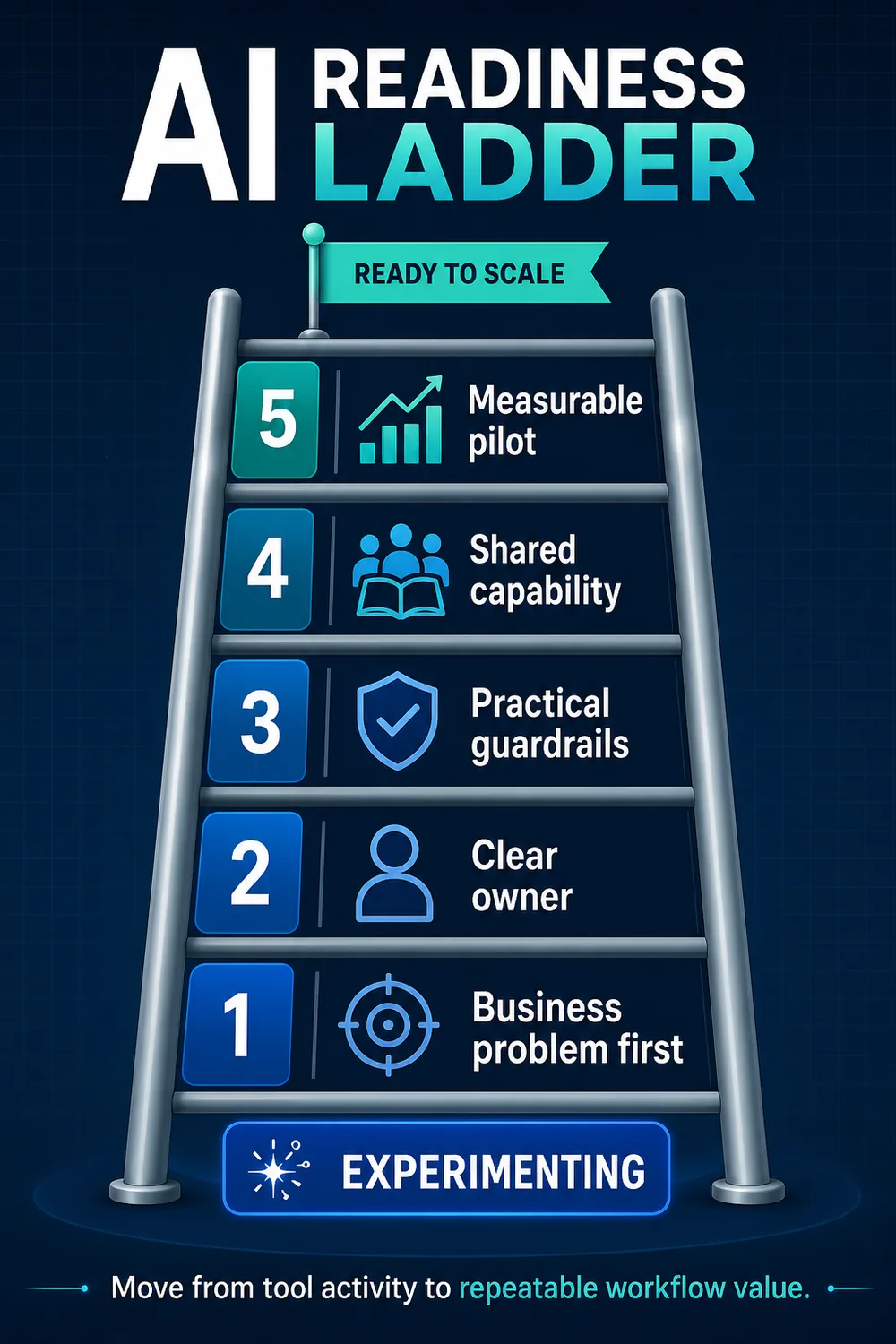
5. You Can Measure a Pilot and Make a Decision From It
A pilot is not just a demonstration.
A useful AI pilot should help leadership decide what to do next.
Before starting, define:
- The workflow being improved
- The baseline condition
- The expected outcome
- The people involved
- The data and risk boundaries
- The measure of success
- The decision date for determining whether to scale, improve, pause, or stop
The measure does not have to be complicated.
It might be time saved, fewer manual steps, faster response, greater consistency, improved quality, reduced rework, increased capacity, or stronger employee confidence.
What matters is that the organization can distinguish activity from evidence.
If a pilot ends with “people seemed to like it,” that is useful feedback. But it is not yet a business case.
A Simple AI Readiness Test
Leadership teams can get a useful initial view of their AI readiness by answering six questions:
- What business priority or workflow problem are we trying to improve?
- Who owns the business outcome and the implementation decision?
- What information can be used safely, and what guardrails are needed?
- Which users need to be involved, trained, or supported?
- What baseline and success measures will we use?
- What decision will we make at the end of the pilot: scale, redesign, pause, or stop?
If the answers are vague, that does not mean the organization should wait indefinitely.
It may simply mean that the next step is not another tool purchase.
A readiness review, workflow assessment, or use-case prioritization exercise may provide more value by helping leadership determine where AI belongs and what conditions need to be addressed first.
If the answers are clear enough to support a focused pilot, the organization may be ready to move from experimentation toward structured adoption.
Readiness Is a Progression, Not a Label
AI readiness is not a binary status.
A business can be ready to assess its opportunities without being ready to implement them. It can be ready to run one focused pilot without being ready to scale AI across every department.
That progression is normal.
A practical path often looks like this:
- Assess the current situation across people, processes, data, tools, and risk.
- Align leaders on the business priorities that matter most.
- Identify and prioritize realistic use cases based on value, feasibility, risk, ownership, and measurability.
- Build appropriate guardrails and adoption support.
- Run a focused, measurable pilot.
- Decide what happens next: scale, improve, pause, or stop.
This is not necessarily slower than jumping from tool to tool.
In many cases, it is the faster way to reduce wasted effort, avoid unnecessary risk, and focus investment on opportunities that can create meaningful leverage.
Experimenting With AI vs. Being AI Ready
The difference becomes easier to see when the two stages are compared directly.
| Experimenting With AI | Building AI Readiness |
|---|---|
| Starting with a tool | Starting with a business problem or workflow |
| Individual productivity gains | Repeatable workflow improvement |
| Unclear ownership | Defined sponsor and process owner |
| Informal AI use | Approved tools and practical guardrails |
| Knowledge held by a few enthusiasts | Role-based training and shared standards |
| Success measured by usage | Success measured by business outcomes |
| Pilots with no clear endpoint | Pilots designed to support a scale, refine, pause, or stop decision |
Organizations do not need to eliminate experimentation to become more AI ready.
They need to connect experimentation to a clearer system for deciding what matters, what is safe, what can be measured, and what should happen next.
The Next Question Is Not “Which AI Tool Should We Buy?”
The more useful question is:
Which workflow should we improve first, and what needs to be true for that improvement to be safe, measurable, and repeatable?
That is where practical AI adoption begins.
How WSI AI Advisors Can Help
WSI AI Advisors helps organizations move from scattered AI activity toward a more structured path to measurable business value.
Our work can include AI readiness assessment, workflow review, use-case discovery and prioritization, AI roadmap development, implementation support, team training, and practical governance planning.
The goal is to connect AI opportunities to business priorities, operational realities, responsible use, and clear decisions about what to do next.
If your organization already has people experimenting with AI but no clear path from those experiments to repeatable business value, an AI readiness assessment or workflow review can be a practical first step.
About the Author
The Best Digital Marketing Insight and Advice
The WSI Digital Marketing Blog is your go-to-place to get tips, tricks and best practices on all things digital
marketing related. Check out our latest posts.
Ready to turn AI insight into a practical business plan?
Speak with an AI ConsultantWe are committed to protecting your privacy. For more info, please review our Privacy and Cookie Policies. You may unsubscribe at any time.
Don't stop the learning now!

AI Training Should Improve Work, Not Just Tool Familiarity
Investing in AI training is becoming a priority for businesses that want to work more efficiently, improve customer experiences, and prepare their teams for a changing workplace. But completing an AI training session does not automatically mean employees are ready to use AI well in their day-to-day work. A team may learn how to generate …
Continue reading “AI Training Should Improve Work, Not Just Tool Familiarity”
READ MORE
Responsible AI in Banking: A Practical Strategy for Secure AI Adoption
Artificial intelligence is creating new opportunities for banks and financial institutions to improve operations, reduce repetitive tasks, and support employees in their daily work. However, adopting AI in financial services requires more than selecting the right software. Banks operate in environments where data protection, regulatory requirements, cybersecurity, and customer trust are essential. The challenge is …
Continue reading “Responsible AI in Banking: A Practical Strategy for Secure AI Adoption”
READ MORE
Small businesses do not need to begin AI adoption with a company-wide rollout, a long list of tools, or a vague mandate to “use AI more.” They need one workflow that is already creating friction—and a disciplined way to test whether AI improves it. That is what a 30-day workflow test is for. The goal …
READ MORE