

 604.506.5068
AI

Small businesses do not need to begin AI adoption with a company-wide rollout, a long list of tools, or a vague mandate to “use AI more.”
They need one workflow that is already creating friction—and a disciplined way to test whether AI improves it.
That is what a 30-day workflow test is for.
The goal is not to prove that AI is impressive. It is to find out whether one recurring process becomes faster, more consistent, or easier to manage without creating so much review, correction, or risk that the benefit disappears.
A good first pilot gives you evidence from your own business. Then you can make a better decision: scale, refine, or stop.
Start with one recurring business problem. Test one workflow. Measure the results. Let the evidence guide your next AI investment.
Start Where Inefficiency Already Has a Cost
The best first AI project is rarely the flashiest one.
It is usually a workflow that happens often, follows a reasonably consistent pattern, and creates a visible cost today. That cost might show up as slow turnaround, repetitive administrative work, unnecessary senior involvement, missed follow-ups, or rework that keeps returning to the same people.
Look for work that is:
- Frequent: It happens enough times in a month to produce useful evidence.
- Bounded: It has a clear beginning, end, and expected output.
- Reviewable: A person can verify the result before it affects a customer, payment, contract, or important decision.
- Measurable: You can compare the process before and after the test.
Meeting summaries, first-draft customer responses, recurring report preparation, sales follow-up, internal knowledge retrieval, and CRM updates can be reasonable starting points when they are handled with the right review process.
By contrast, a vague objective such as “use AI in marketing” is not a pilot. It is an invitation to experiment without a clear business question.
Set the Bar Before the Technology Enters the Process
A demo can look useful even when the workflow is not improving.
Before introducing AI, document how the process works today. Keep it simple:
- How long does a completed task take from request to usable final output?
- How many people touch it?
- Where does rework occur?
- What quality standard must be maintained?
- What would count as a meaningful improvement?
Choose one primary measure and no more than two supporting measures.
For example, a business testing AI-assisted meeting follow-up might track:
- Time from meeting end to a reviewed follow-up
- Percentage of action items captured correctly
- Amount of editing required before the summary can be sent
The important measure is not how quickly AI produces a draft. It is whether the completed process improves.
If drafting becomes faster but review, corrections, approvals, or workarounds consume the saved time, the business case is weaker than it first appears.
AI productivity should be measured by the completed workflow—not just the time it takes to generate a first draft.
Keep the First Test Narrow Enough to Learn From
A 30-day pilot should test one workflow, one defined AI role, and one operating hypothesis.
For example:
If AI creates a first draft of meeting summaries and action lists from approved notes, then the team may reduce the time required to prepare follow-up—while keeping human review before anything is shared.
That is a testable hypothesis.
“Let the team try different AI tools and see what happens” is not.
The first pilot should have a named owner, a small group of users, and clear boundaries around what AI can and cannot do. It should also define what information may be used, where human review is mandatory, and when an issue should be escalated.
Human oversight is not evidence that the pilot failed. In many early AI workflows, it is the control that makes the test useful and responsible.
A Practical 30-Day Workflow Test
A structured 30-day test provides a practical framework for moving from AI experimentation to evidence-based decisions.
Days 1–5: Define the Test
Choose one workflow and write down:
- The business problem it creates today
- The workflow owner
- The people involved
- The current process and baseline
- The AI-assisted step being tested
- The success threshold
- The review requirements and data boundaries
- The decision date at the end of the pilot
This can fit on one page. The point is clarity, not bureaucracy.
Days 6–10: Prepare the Workflow
Document the current handoffs. Gather approved source material. Create a simple prompt, template, or checklist. Make sure participants understand what good output looks like and what still requires human judgment.
Do not try to automate the entire process. Start with one contained step: drafting, summarizing, categorizing, extracting, organizing, or preparing a first response.
Days 11–25: Run It on Real Work
Use the workflow in normal operating conditions. Keep a lightweight record of what happened:
- Time required end to end
- Output accepted without major changes
- Corrections or rework needed
- Exceptions and failure points
- Feedback from the people using it
This is where the real learning happens. A workflow that performs well in a clean demonstration may behave differently when inputs are incomplete, timing is tight, or the work reaches a customer-facing handoff.
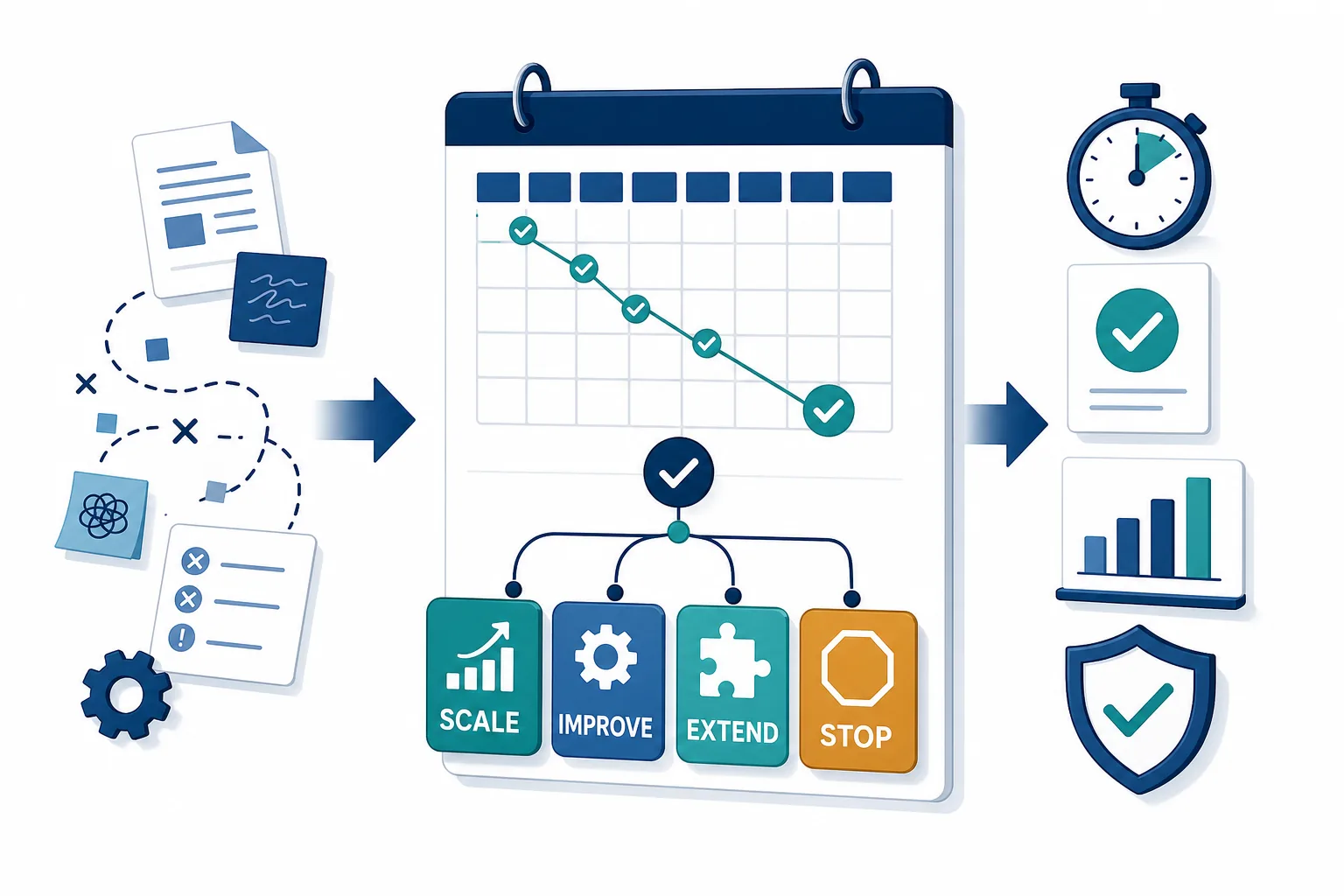
Days 26–30: Make the Decision
Compare the results with the baseline. Then choose one of four paths:
- Scale: The workflow met the threshold, risks are manageable, and the result can be repeated.
- Improve: The opportunity is real, but the prompt, process, training, or controls need work.
- Extend: The test needs more examples because the workflow is seasonal or the sample was too small.
- Stop: The benefit was too small, the review burden was too high, or the risk was not acceptable.
Stopping a weak pilot is not failure. It is a better outcome than scaling the wrong workflow because the technology looked promising in a demo.

Measure Four Things, Not Just Time Saved
A useful AI pilot scorecard looks beyond speed.
| Dimension | Question to Ask |
|---|---|
| Time | Did the end-to-end workflow take less time? |
| Quality | Was the reviewed output accurate, useful, and consistent with the required standard? |
| Rework | Did checking and correction erase the apparent time savings? |
| Risk | Did the workflow create privacy, data-handling, customer-impact, or governance concerns? |
You may also track adoption: did the people doing the work use the process consistently, or did they create workarounds?
A pilot that saves a few minutes but no one wants to use is not yet a scalable operating pattern.
Good First Pilots—and Poor Ones
Good first pilots usually support human work rather than replace high-stakes judgment.
Examples include:
- Turning meeting notes into a reviewed action summary
- Drafting routine customer follow-ups from approved information
- Converting call notes into CRM updates for review
- Preparing a first draft of a recurring internal report
- Organizing recurring internal questions into a draft knowledge resource
Poor first pilots include workflows where errors can create serious consequences or where the process itself is not yet clear. Avoid starting with final hiring decisions, legal or financial judgments, unsupervised customer communications, or confidential data in unapproved systems.
If your work is highly specialized, do not assume AI has no place. The first opportunity may be in the supporting work around expert judgment: preparation, summarization, documentation, follow-up, or first drafts.
Start with workflows where AI can support people, results can be checked, and risks can be managed.
The First Win Is a Better Decision
The right first AI project is not the one that sounds most advanced.
It is the one that helps your business answer a practical question with evidence:
Can AI improve this workflow enough to justify the next investment?
Start with one recurring problem. Set the baseline. Keep the scope narrow. Measure the completed process. Keep people accountable for the work that matters.
Then let the result—not the hype—decide what comes next.
If you are unsure which workflow is the right place to start, begin with a workflow review: identify where time, rework, and bottlenecks are already costing the business, then choose the smallest test that can produce a credible answer.
How WSI AI Advisors Can Help
WSI AI Advisors helps businesses identify practical opportunities for AI adoption and connect those opportunities to measurable operational improvements.
Through workflow reviews, AI readiness assessments, use-case prioritization, and implementation planning, businesses can take a more structured approach to testing AI without committing to unnecessary complexity.
Whether you are exploring your first AI application or looking to turn isolated experiments into repeatable business value, the starting point is understanding where AI can make a meaningful difference.
About the Author
The Best Digital Marketing Insight and Advice
The WSI Digital Marketing Blog is your go-to-place to get tips, tricks and best practices on all things digital
marketing related. Check out our latest posts.
Ready to turn AI insight into a practical business plan?
Speak with an AI ConsultantWe are committed to protecting your privacy. For more info, please review our Privacy and Cookie Policies. You may unsubscribe at any time.
Don't stop the learning now!

AI Training Should Improve Work, Not Just Tool Familiarity
Investing in AI training is becoming a priority for businesses that want to work more efficiently, improve customer experiences, and prepare their teams for a changing workplace. But completing an AI training session does not automatically mean employees are ready to use AI well in their day-to-day work. A team may learn how to generate …
Continue reading “AI Training Should Improve Work, Not Just Tool Familiarity”
READ MORE
Responsible AI in Banking: A Practical Strategy for Secure AI Adoption
Artificial intelligence is creating new opportunities for banks and financial institutions to improve operations, reduce repetitive tasks, and support employees in their daily work. However, adopting AI in financial services requires more than selecting the right software. Banks operate in environments where data protection, regulatory requirements, cybersecurity, and customer trust are essential. The challenge is …
Continue reading “Responsible AI in Banking: A Practical Strategy for Secure AI Adoption”
READ MORE
AI Ready or Just Experimenting With AI Tools? A Practical Way to Tell
Many businesses are already using AI. Someone is drafting with ChatGPT. A sales team is using AI to research prospects. Marketing is testing new content tools. Operations is looking for ways to reduce repetitive work. That activity can be useful. It can reveal where people see friction, where time is being lost, and where teams …
Continue reading “AI Ready or Just Experimenting With AI Tools? A Practical Way to Tell”
READ MORE