

 604.506.5068
AI
Responsible AI in Banking: A Practical Strategy for Secure AI Adoption

Continue reading "Responsible AI in Banking: A Practical Strategy for Secure AI Adoption"
Artificial intelligence is creating new opportunities for banks and financial institutions to improve operations, reduce repetitive tasks, and support employees in their daily work.
However, adopting AI in financial services requires more than selecting the right software. Banks operate in environments where data protection, regulatory requirements, cybersecurity, and customer trust are essential.
The challenge is finding ways to introduce AI without compromising those responsibilities.
For banking leaders, the most effective approach is not necessarily the fastest rollout. It is a structured process that combines clear business priorities, responsible AI governance, employee training, and measurable operational improvements.
Successful AI adoption in banking is not about implementing more technology. It is about improving business processes while protecting the trust that financial institutions depend on.
Why Responsible AI Adoption Matters in Banking
Banks face increasing pressure to operate efficiently while maintaining the standards expected of highly regulated institutions.
Employees spend considerable time preparing reports, reviewing information, conducting research, organizing documents, and completing administrative tasks. Many of these activities contain opportunities for AI-assisted improvements.
Yet introducing AI without a clear strategy can create additional challenges.
- Data security: Sensitive customer and financial information must remain protected.
- Regulatory compliance: AI-supported processes must operate within applicable legal and industry requirements.
- Accuracy: AI-generated information needs appropriate verification before it influences important decisions.
- Accountability: Organizations must define who is responsible for reviewing outputs and approving actions.
- Employee readiness: Teams need practical training and clear expectations before adopting new workflows.
- Measurable value: Technology investments should produce identifiable operational improvements.
These considerations do not mean financial institutions should avoid AI. They highlight the importance of establishing a responsible adoption framework before expanding its use.
What a Real Banking AI Adoption Experience Can Teach Us
An example from the broader WSI network illustrates how a financial institution can move from exploring AI to developing a more structured adoption program.
Forward Bank, a community-focused financial institution serving customers in Wisconsin and Minnesota, worked with WSI consulting professionals to evaluate practical opportunities for AI while addressing the operational requirements of banking.
The initiative focused on connecting AI experimentation to processes that could be reviewed, measured, and supported by employees.
Rather than treating AI as a collection of individual tools, the program incorporated several complementary elements:
- Responsible AI policies and governance procedures
- Practical employee training
- Department-level workflow evaluations
- Internal AI champions and ongoing knowledge sharing
- Measurement of operational results
- Continued review of potential AI applications
This example demonstrates an important principle: AI becomes more valuable when organizations create a repeatable system for identifying opportunities, managing risks, and evaluating outcomes.
For more details about the project, explore the Forward Bank responsible AI adoption case study published by WSI.
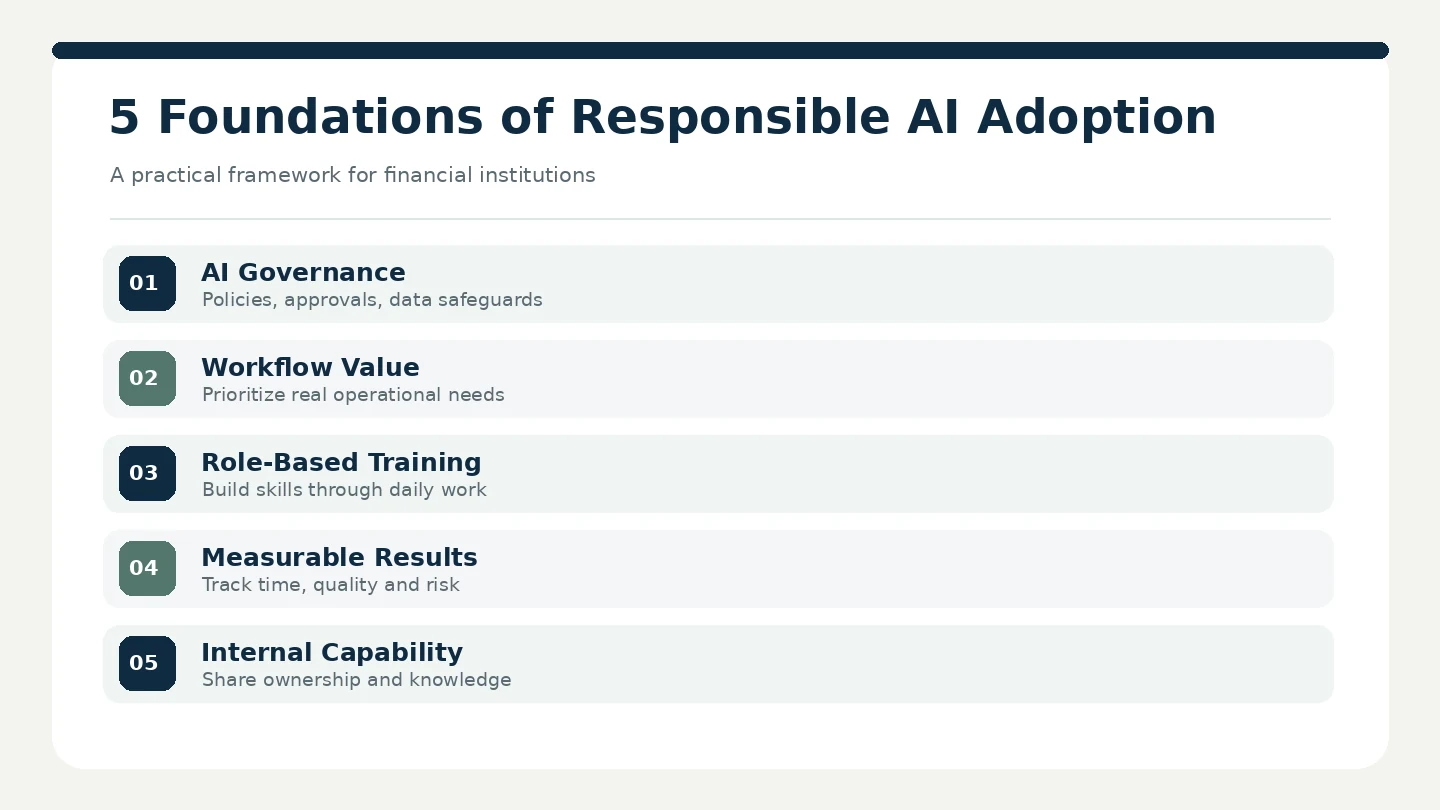
Five Foundations of a Responsible AI Strategy for Financial Institutions
Financial institutions do not need to transform every department simultaneously. They need a clear foundation that allows AI adoption to develop in a controlled and practical way.
1. Establish AI Governance Before Expanding Adoption
AI governance provides the operating guidelines employees need when evaluating new tools and applying AI to existing processes.
Without clear policies, employees may experiment with technology without understanding which information is appropriate to share, what approvals are required, or when human verification is mandatory.
A practical governance framework should answer several questions:
- Which AI platforms and applications are approved?
- What types of customer or business information can be processed?
- Who evaluates new AI use cases?
- Which activities require human oversight?
- How are potential errors, privacy concerns, and security issues escalated?
- How will compliance with organizational policies be monitored?
The goal is not to create unnecessary administrative barriers. It is to give employees a clear and secure way to explore useful applications.
Good AI governance does more than reduce risk. It creates the conditions for responsible innovation.
2. Identify Workflows With Clear Business Value
One of the most common mistakes in AI implementation is selecting technology before identifying the operational problem it should solve.
A stronger approach begins with reviewing existing workflows and identifying activities that are repetitive, time-consuming, or difficult to coordinate.
For example, banks may evaluate opportunities involving:
- Internal reporting and document preparation
- Administrative research and information retrieval
- Financial and operational data organization
- Marketing content development and review
- Preparation of compliance documentation
- Internal knowledge management
- Meeting summaries and follow-up coordination
Each opportunity should be evaluated according to expected business value, implementation feasibility, available data, security requirements, and the amount of human review needed.
The strongest early projects often involve improving a specific part of an existing process rather than attempting to automate an entire department.
3. Make AI Training Relevant to Employees’ Roles
AI training is more effective when employees can immediately connect the technology to responsibilities they already understand.
A generic demonstration may introduce useful capabilities, but it does not necessarily explain how AI should be applied within the operational requirements of a bank.
Role-based training can help teams understand how to:
- Identify appropriate AI applications in daily work
- Use approved tools and information sources
- Create more consistent instructions and prompts
- Review AI-generated outputs for accuracy
- Recognize situations that require human judgment
- Document and share successful processes
Organizations can also create internal AI champion groups that bring together employees from different departments to exchange experiences, identify challenges, and share approved practices.
This approach helps prevent valuable knowledge from remaining with only a small number of technically confident employees.
4. Measure Workflow Improvements, Not Just AI Usage
Knowing how many employees use an AI tool is not the same as knowing whether the organization has improved its operations.
For meaningful evaluation, financial institutions should establish a baseline before implementing an AI-assisted workflow.
Useful measurements may include:
- Time required to complete a process
- Number of manual steps involved
- Frequency of corrections and rework
- Accuracy and consistency of completed outputs
- Employee adoption and satisfaction
- Security, compliance, and review requirements
These measurements allow organizations to distinguish actual operational improvements from promising demonstrations.
They also support more informed decisions about whether an AI project should be expanded, adjusted, or discontinued.
5. Build Internal Capabilities for Long-Term Adoption
External expertise can accelerate AI planning and implementation, but sustainable results depend on the organization’s ability to manage and improve its own processes.
Leaders should work toward building internal knowledge, clear ownership, repeatable procedures, and a culture of responsible experimentation.
When employees understand both the opportunities and limitations of AI, they become better equipped to identify meaningful improvements.
Over time, this creates a stronger foundation for expanding AI beyond isolated projects.
What Measurable AI Adoption Can Look Like in Banking
The Forward Bank experience, documented by the WSI network, offers examples of how structured AI adoption can translate into measurable operational gains.
During one reporting period, the bank estimated approximately 276 hours saved across departments through the use of Microsoft Copilot.
Additional workflow reviews identified improvements in several recurring activities.
| Banking Workflow | Reported Improvement |
|---|---|
| Enterprise risk management data extraction | Approximately 80–90% less processing time in the evaluated workflow. |
| Specialized trust-account reporting | Processing time decreased from about two hours to 30 minutes per cycle. |
| Marketing accounting preparation | A task previously requiring over 30 minutes was reduced to approximately 5–10 minutes. |
| Annual donation-list comparisons | AI-assisted matching reduced preparation time by approximately 83–92%. |
These figures represent findings reported for specific processes at Forward Bank. They should not be interpreted as guaranteed outcomes for other financial institutions. The results were documented in the WSI case study on responsible AI adoption in banking.
The organization also identified potential future efficiency improvements in compliance-related activities. Those estimates represented opportunities dependent on implementation, rather than savings already achieved.
The broader lesson is that even relatively small improvements in recurring administrative processes can become meaningful when applied consistently across an organization.
The strongest business case for AI comes from measured improvements in real workflows—not from the number of tools an organization adopts.
A Practical AI Adoption Roadmap for Banks
Financial institutions considering AI adoption can begin with a manageable sequence of actions rather than launching a large transformation initiative.
Step 1: Assess Organizational AI Readiness
Evaluate current processes, technology, employee capabilities, data policies, leadership priorities, and existing AI experimentation.
The objective is to understand where the organization is starting and which conditions need attention before implementation.
Step 2: Prioritize Business Use Cases
Identify a shortlist of opportunities where AI could reduce repetitive work, improve consistency, or support employee productivity.
Prioritize applications based on business impact, feasibility, available resources, and risk.
Step 3: Define Security and Governance Requirements
Before testing, establish the tools, information boundaries, approval processes, and human review standards required for each proposed application.
Step 4: Launch a Focused Pilot
Choose a controlled workflow, assign an accountable owner, and define a clear measurement process.
A short pilot can help the team identify operational challenges before considering broader implementation.
Step 5: Evaluate Results and Plan the Next Phase
Compare the pilot results against the original baseline and evaluate quality, time savings, employee experience, and remaining risks.
Use the evidence to decide whether the workflow should be expanded, improved, tested further, or discontinued.
AI Experimentation vs. Responsible AI Adoption
Understanding the difference between informal experimentation and a structured AI program helps financial institutions make more informed technology decisions.
| Informal AI Experimentation | Responsible AI Adoption |
|---|---|
| Employees select tools independently | Approved tools and defined usage policies |
| Projects begin with technology | Projects begin with business needs |
| Unclear data-handling practices | Defined security and information boundaries |
| Training focuses on software features | Training focuses on real employee workflows |
| Success measured by tool activity | Success measured by operational outcomes |
| Knowledge remains with individual users | Processes and expertise are shared across teams |
| Expansion occurs without clear evidence | Expansion follows evaluation and business review |
Experimentation remains useful. The important step is connecting what employees learn to a broader framework that protects the business and supports measurable improvement.
Why AI Governance and Human Oversight Remain Essential
AI can assist with research, document preparation, information analysis, and other supporting tasks. However, automation does not eliminate the need for professional judgment or institutional accountability.
In financial services, human oversight is particularly important when outputs may influence customer outcomes, regulatory reporting, confidential information, or consequential business decisions.
Organizations should establish procedures that make it clear:
- When an AI-generated result requires verification
- Which decisions remain exclusively under human authority
- How data access and privacy are controlled
- How AI-related concerns are documented and escalated
- Who is responsible for ongoing monitoring
Responsible AI adoption should strengthen existing business controls rather than create uncertainty around them.
How WSI AI Advisors Can Help Financial Businesses Move Forward
Introducing AI responsibly requires connecting technology opportunities with business strategy, employee capabilities, operational workflows, and appropriate risk management.
WSI AI Advisors helps organizations approach AI adoption through a practical, business-focused framework.
Depending on organizational needs, the consulting process can address:
- AI readiness assessments: Evaluate the organization’s current capabilities and opportunities for improvement.
- AI strategy development: Connect implementation priorities to measurable business objectives.
- Workflow analysis: Identify processes where AI could create meaningful efficiency gains.
- Use-case prioritization: Focus resources on opportunities with appropriate value, feasibility, and risk.
- AI governance planning: Develop practical policies and oversight processes for responsible adoption.
- Employee training: Help teams understand how to apply AI within their roles.
- Implementation planning: Establish manageable pilot projects and evaluate outcomes before expanding.
For banks and other regulated businesses, implementation should also involve the appropriate internal compliance, cybersecurity, legal, and operational stakeholders.
The objective is not to introduce AI everywhere at once. It is to identify where technology can generate sustainable business value while maintaining clear accountability.
Frequently Asked Questions About AI Adoption in Banking
What is responsible AI adoption in banking?
Responsible AI adoption involves introducing artificial intelligence into banking operations with appropriate governance, security controls, human oversight, and measurable business objectives. The goal is to improve processes while managing operational and regulatory risks.
How can banks use AI without compromising security?
Banks can begin by using approved technology, establishing clear data-handling requirements, reviewing access permissions, defining acceptable use cases, and maintaining appropriate human verification. Security and compliance teams should participate in evaluating new applications.
What are good first AI projects for financial institutions?
Appropriate starting points may include internal document summarization, administrative reporting, research preparation, knowledge retrieval, and other reviewable support activities. Each use case should be evaluated for data sensitivity, accuracy requirements, and potential consequences of error.
How can banks measure the return on AI investments?
Financial institutions can compare baseline workflow performance with the results of an AI-assisted process. Useful measures include total completion time, output quality, correction effort, employee adoption, implementation costs, and risk-related requirements.
Can Microsoft Copilot be used in regulated financial services?
Microsoft Copilot may be considered for banking workflows when its configuration, permissions, information access, cybersecurity controls, and regulatory implications have been appropriately evaluated. Organizations should confirm that the intended use fits their internal requirements before deployment.
Why should financial institutions consider AI consulting?
AI consulting can help organizations evaluate readiness, identify realistic opportunities, prioritize investments, develop implementation roadmaps, and create practical governance and training plans. A structured approach can also help reduce disconnected experimentation and improve decision-making.
How can WSI AI Advisors help a business get started with AI?
WSI AI Advisors can help businesses begin with an AI readiness or workflow review, evaluate potential applications, and develop a strategy that connects AI opportunities to business objectives, responsible-use practices, and measurable outcomes.
Build an AI Strategy That Supports Growth and Trust
The future of AI in banking is not simply about faster technology or greater automation. It is about giving financial institutions better ways to manage information, support employees, improve operations, and serve customers responsibly.
Organizations that combine clear governance, relevant training, targeted workflow improvements, and consistent measurement are better positioned to evaluate where AI belongs in their operations.
The most valuable first step may not be another software purchase. It may be understanding where your existing processes are creating unnecessary cost, delay, or complexity.
Responsible AI starts with the right business problem, a clear plan, and a commitment to measurable improvement.
If your organization is exploring AI but needs a clearer path from experimentation to practical business value, WSI AI Advisors can help you evaluate opportunities and determine the next step.
About the Author
The Best Digital Marketing Insight and Advice
The WSI Digital Marketing Blog is your go-to-place to get tips, tricks and best practices on all things digital
marketing related. Check out our latest posts.
Ready to turn AI insight into a practical business plan?
Speak with an AI ConsultantWe are committed to protecting your privacy. For more info, please review our Privacy and Cookie Policies. You may unsubscribe at any time.
Don't stop the learning now!

AI Training Should Improve Work, Not Just Tool Familiarity
Investing in AI training is becoming a priority for businesses that want to work more efficiently, improve customer experiences, and prepare their teams for a changing workplace. But completing an AI training session does not automatically mean employees are ready to use AI well in their day-to-day work. A team may learn how to generate …
Continue reading “AI Training Should Improve Work, Not Just Tool Familiarity”
READ MORE
Small businesses do not need to begin AI adoption with a company-wide rollout, a long list of tools, or a vague mandate to “use AI more.” They need one workflow that is already creating friction—and a disciplined way to test whether AI improves it. That is what a 30-day workflow test is for. The goal …
READ MORE
AI Ready or Just Experimenting With AI Tools? A Practical Way to Tell
Many businesses are already using AI. Someone is drafting with ChatGPT. A sales team is using AI to research prospects. Marketing is testing new content tools. Operations is looking for ways to reduce repetitive work. That activity can be useful. It can reveal where people see friction, where time is being lost, and where teams …
Continue reading “AI Ready or Just Experimenting With AI Tools? A Practical Way to Tell”
READ MORE