

 604.506.5068
AI
AI for Manufacturing Operations: A Practical Roadmap for Supply Chain Visibility, Procurement, and Demand Forecasting

AI for Manufacturing Operations: A Practical Roadmap for Supply Chain, Procurement, and Demand Forecasting
Manufacturers do not need to begin their AI journey with a company-wide transformation program.
The most practical starting point is usually a workflow where teams are already losing time: chasing late supplier updates, reconciling inventory data, expediting purchase orders, or revising forecasts after the production plan has already been affected.
For mid-sized manufacturers, AI creates value when it improves the quality and speed of operational decisions. That means starting with a defined problem, usable data, clear ownership, and a pilot that can be measured.
This guide focuses on three connected areas where AI can create early operational value:
- Supply chain visibility
- Procurement prioritization
- Demand forecasting
It also outlines a phased implementation roadmap and governance practices that help adoption become sustainable.
Where AI Creates Real Value in Manufacturing Workflows
AI is not a replacement for manufacturing expertise, supplier relationships, or operational judgment.
Its strongest role is to help people identify patterns earlier, prioritize what needs attention, and make better decisions with the data they already have.
In supply chain and procurement workflows, that often means reducing the time between a signal and an action.
For example, a planner may know that a supplier delay matters. The challenge is determining which late order will affect production first, which customer commitments are exposed, what inventory alternatives exist, and who needs to make the next decision.
AI can support that workflow by bringing together signals from ERP, purchasing, inventory, production scheduling, supplier communications, and demand data. The value is not simply a dashboard. It is a clearer, faster path to action.
1. Supply Chain Visibility: Detecting Risk Before It Becomes a Production Problem
Supply chain teams often work with fragmented information. Supplier confirmations may sit in email. Inventory data may live in ERP. Production schedules may change faster than reports are updated. By the time a shortage is visible, the team may already be expediting materials or adjusting production.
AI can help identify risk patterns earlier by monitoring the signals that matter across the workflow.
Scenario: Late Supplier Commitments Affecting Production
A manufacturer depends on several components with long lead times. Purchase orders appear open in the ERP system, but supplier confirmations are inconsistent and delivery dates are frequently revised.
An AI-supported workflow can flag orders where supplier delivery risk, current inventory, production demand, and lead-time variability create a likely material shortage. Instead of reviewing every open order manually, the procurement team receives a prioritized list of items that require follow-up.
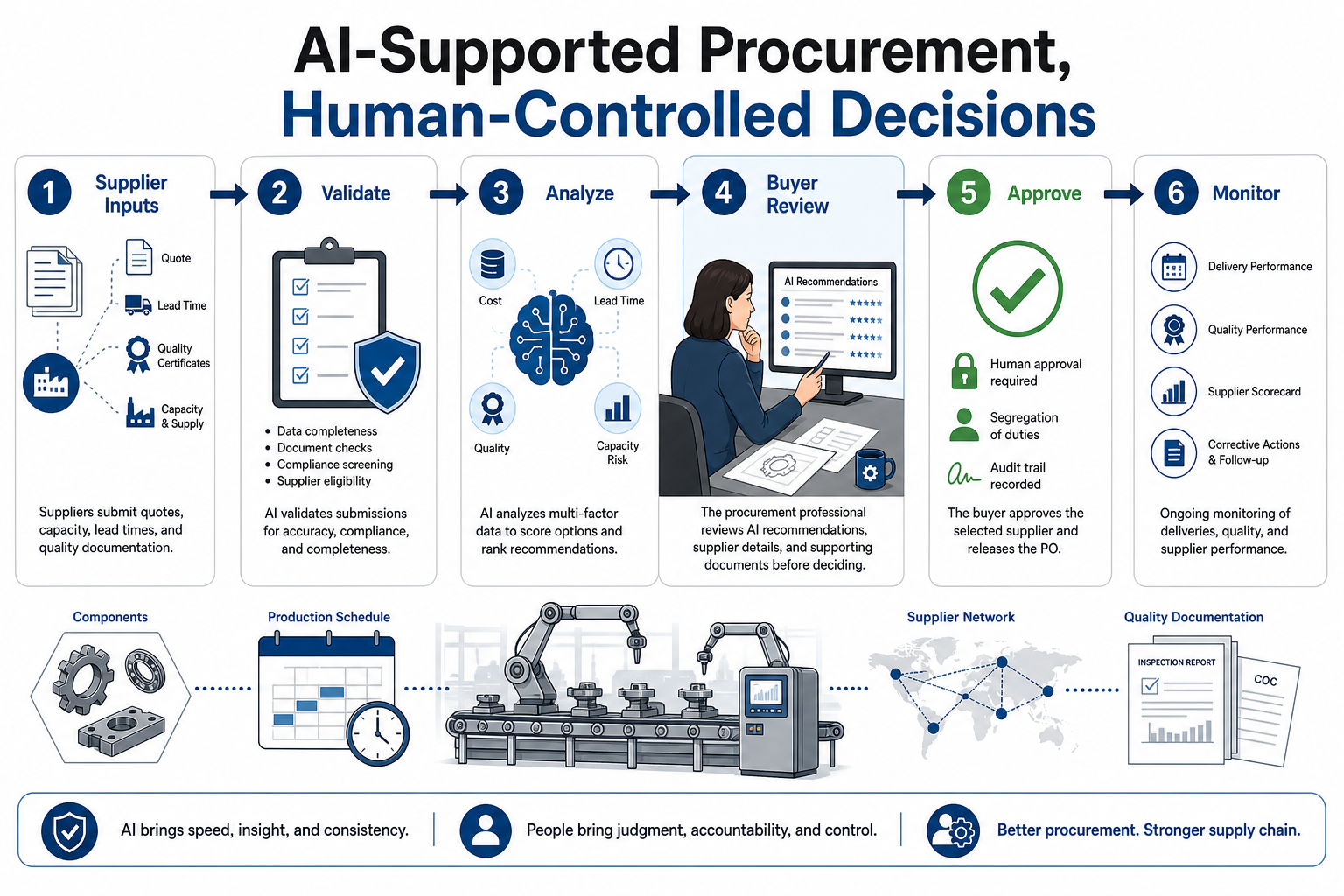
The human decision remains essential. The buyer still decides whether to contact the supplier, approve an alternate source, adjust the production plan, or escalate the issue. AI helps the team see the problem earlier and focus attention where the operational impact is greatest.
Scenario: Inventory Risk Across Multiple Facilities
A mid-sized manufacturer operates more than one location. One facility has excess inventory of a component while another is at risk of a shortage. The issue is not a lack of data. It is the time required to spot the imbalance, validate it, and coordinate a transfer.
AI can help surface inventory exceptions by comparing available stock, planned demand, transfer lead times, and safety-stock thresholds. A planner can then review recommended actions before approving a transfer or changing a replenishment plan.
The quick win is improved visibility. The longer-term value is a more disciplined exception-management process.
What to Measure
- Number of material shortages identified before production is affected
- Time from risk signal to buyer or planner action
- Expedite costs
- Schedule disruption caused by material availability
- Inventory transfers or substitutions completed before a shortage occurs
2. Procurement Prioritization: Helping Buyers Focus on the Decisions That Matter Most
Procurement teams rarely lack work. They lack a reliable way to distinguish routine activity from decisions that could affect production, margins, service levels, or working capital.
AI can help buyers prioritize purchase orders, suppliers, and exceptions based on operational impact rather than on whichever issue appears first in an inbox.
Scenario: Prioritizing Purchase Orders by Business Impact
A buyer may manage hundreds of open purchase orders. Some are late but low impact. Others are only slightly delayed but support a high-priority production run or a key customer order.
An AI-supported prioritization model can rank open orders using factors such as required date, supplier reliability, inventory position, production dependency, order value, and customer commitment. The model does not replace the buyer’s judgment. It gives the buyer a more useful starting point each morning.
The result is a shift from reacting to the loudest problem to managing the most consequential one.
Scenario: Identifying Supplier Performance Patterns
Supplier scorecards are useful, but they can be backward-looking. A supplier may still meet an overall delivery target while becoming less reliable on a particular category, facility, or component family.
AI can help identify patterns in late deliveries, partial shipments, price variance, quality issues, and communication delays. Procurement leaders can then investigate whether the issue is temporary, systemic, or tied to a specific product line.
This supports better supplier conversations and stronger sourcing decisions without assuming that every variance requires a supplier change.
What to Measure
- Buyer time spent on manual order review
- Percentage of high-impact exceptions addressed before escalation
- Purchase-order expedite activity
- Supplier follow-up cycle time
- On-time delivery performance for critical materials
- Price, quality, or delivery variance identified early enough to act
3. Demand Forecasting: Improving the Signal Before It Drives the Plan
Demand forecasting is difficult because the forecast is not just a number. It affects purchasing, production capacity, inventory, staffing, and customer commitments.
Many manufacturers still rely on spreadsheets, historical averages, sales input, and periodic forecast reviews. Those methods can be useful, but they often struggle when demand patterns shift, product mix changes, promotions occur, or customer orders become less predictable.
AI can support demand forecasting by detecting patterns across historical sales, order history, seasonality, customer behavior, production constraints, and relevant business events.
Scenario: Forecasting at the Product-Family Level
A manufacturer has a broad product portfolio. Forecast accuracy at the individual SKU level is inconsistent, but product-family demand shows clearer patterns.
Rather than attempting to automate every forecast decision, the team starts with a focused pilot. AI generates a forecast at the product-family level, highlights material changes from the existing forecast, and explains the drivers that may require planner review.
The planner remains accountable for the final forecast. The AI-supported process helps direct attention to the assumptions most likely to affect the plan.
Scenario: Detecting Demand Changes Earlier
A sales team begins receiving changes in customer order patterns. The information exists in CRM, order-entry systems, and account conversations, but it is not always reflected quickly in the formal demand plan.
An AI workflow can help flag unusual order behavior, such as accelerated buying, reduced order frequency, or significant changes in product mix. Demand planners can then validate the signal with sales and decide whether the forecast should be revised.
The goal is not perfect prediction. It is earlier recognition of meaningful change.
What to Measure
- Forecast accuracy for the selected product family or time horizon
- Frequency and size of forecast overrides
- Time required to prepare a forecast review
- Inventory exposure caused by forecast error
- Production-plan changes linked to demand volatility
- Planner confidence in the forecast review process
A Phased AI Implementation Roadmap for Mid-Sized Manufacturers
A practical AI roadmap should move from workflow clarity to controlled implementation. It should not begin by selecting a tool and searching for a problem to solve.
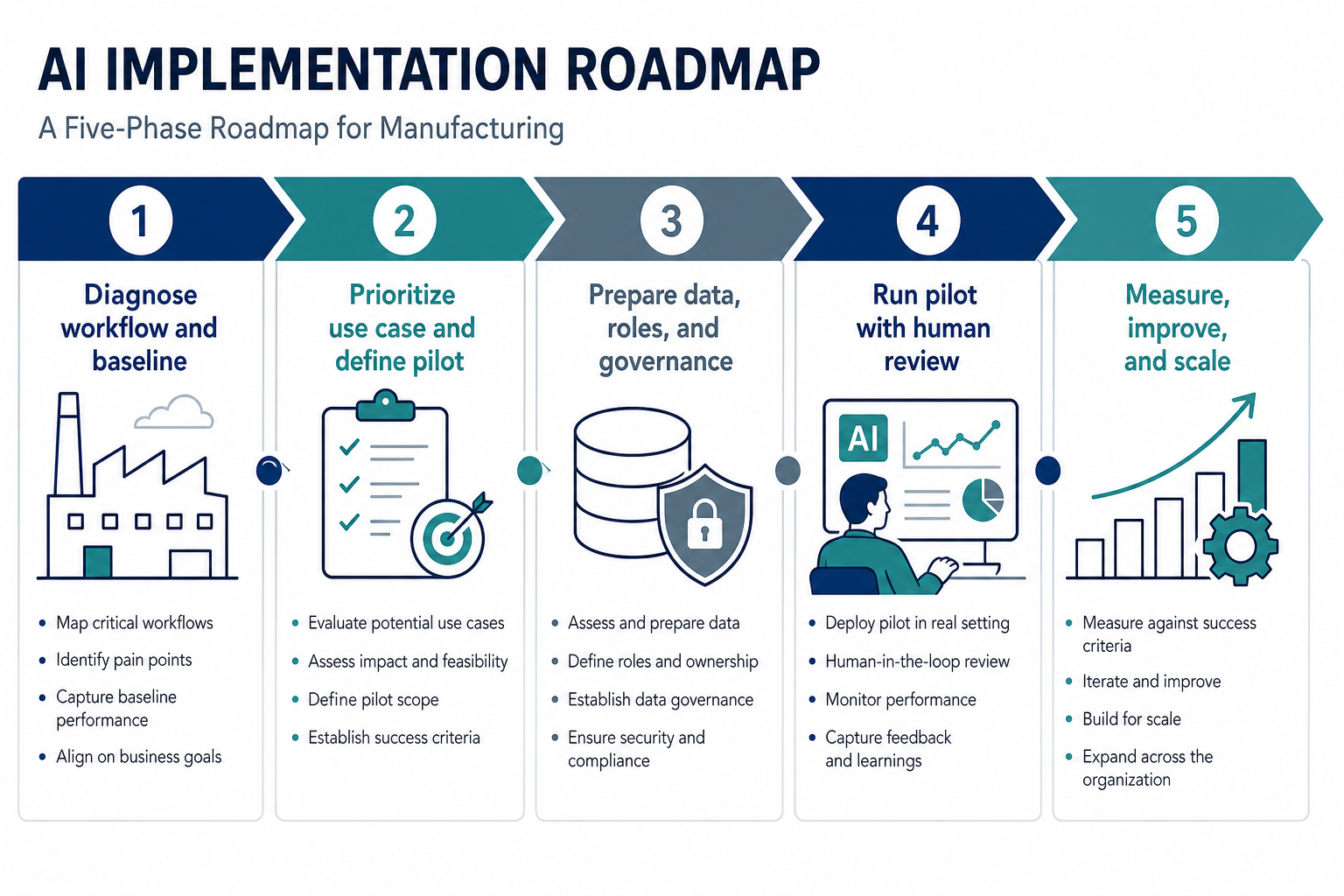
Phase 1: Diagnose the Workflow and Establish a Baseline
Start with one workflow in supply chain, procurement, or demand planning.
Document:
- The decision the team is trying to make
- The people responsible for that decision
- The systems and data sources involved
- The current delays, rework, exceptions, and escalation points
- The operational and financial measures that define improvement
This phase often reveals that the immediate problem is not AI readiness alone. It may be inconsistent data ownership, unclear approval rights, disconnected systems, or a process that has never been standardized.
That is useful information. AI should improve a workflow, not hide its underlying problems.
Phase 2: Prioritize One Use Case and Define the Pilot
Choose a use case that is important enough to matter but narrow enough to manage.
A strong pilot usually has:
- A defined workflow owner
- A measurable business outcome
- Available data, even if it needs cleanup
- A limited user group
- A clear human-review step
- A practical decision that can improve with earlier visibility or better prioritization
For example, a procurement pilot might focus on identifying the top 20 purchase orders each week that pose the greatest risk to production. A demand forecasting pilot might focus on one product family, one region, or one planning horizon.
Phase 3: Prepare Data, Roles, and Governance Before Deployment
Governance should begin before the pilot goes live, not after the organization has already created new risk.
At this stage, establish:
- Data owners for the inputs used by the AI workflow
- Basic data-quality standards for completeness, timeliness, and accuracy
- Approval gates for changes to the model, workflow, or decision rules
- Human-review requirements for consequential decisions
- Escalation paths when the AI output conflicts with operational judgment
- Security, privacy, and compliance checks appropriate to the data and use case
The NIST AI Risk Management Framework provides a useful reference for thinking about AI governance as an ongoing process of governing, mapping, measuring, and managing risk rather than as a one-time compliance exercise.
Phase 4: Run the Pilot With Human Review and Clear Feedback Loops
During the pilot, keep the scope controlled.
The team should know:
- What the AI is expected to do
- What it is not authorized to do
- Who reviews the output
- What happens when the output is wrong, incomplete, or unclear
- How feedback is captured and used to improve the workflow
This is where change management becomes operational. Training should focus on the real workflow, not generic AI awareness. Buyers, planners, supply chain leaders, IT, finance, and compliance stakeholders need a shared understanding of the purpose, limits, and escalation process.
Phase 5: Measure Results, Improve Controls, and Scale Deliberately
After the pilot, compare outcomes against the baseline.
Ask:
- Did the team identify risks earlier?
- Did decision time improve?
- Did the workflow reduce expedite activity, inventory exposure, or schedule disruption?
- Did users trust the output enough to incorporate it into their work?
- Did the governance controls work in practice?
If the pilot demonstrates value, scale to adjacent workflows. If it does not, identify whether the issue was data quality, workflow design, user adoption, model performance, or an unrealistic use-case expectation.
Scaling should be a decision, not an assumption.
Translate AI ambition into a practical, staged plan.
Governance Milestones That Should Grow With AI Adoption
Governance does not need to be heavy at the start. It needs to be proportionate to the use case and mature as AI becomes more embedded in operations.
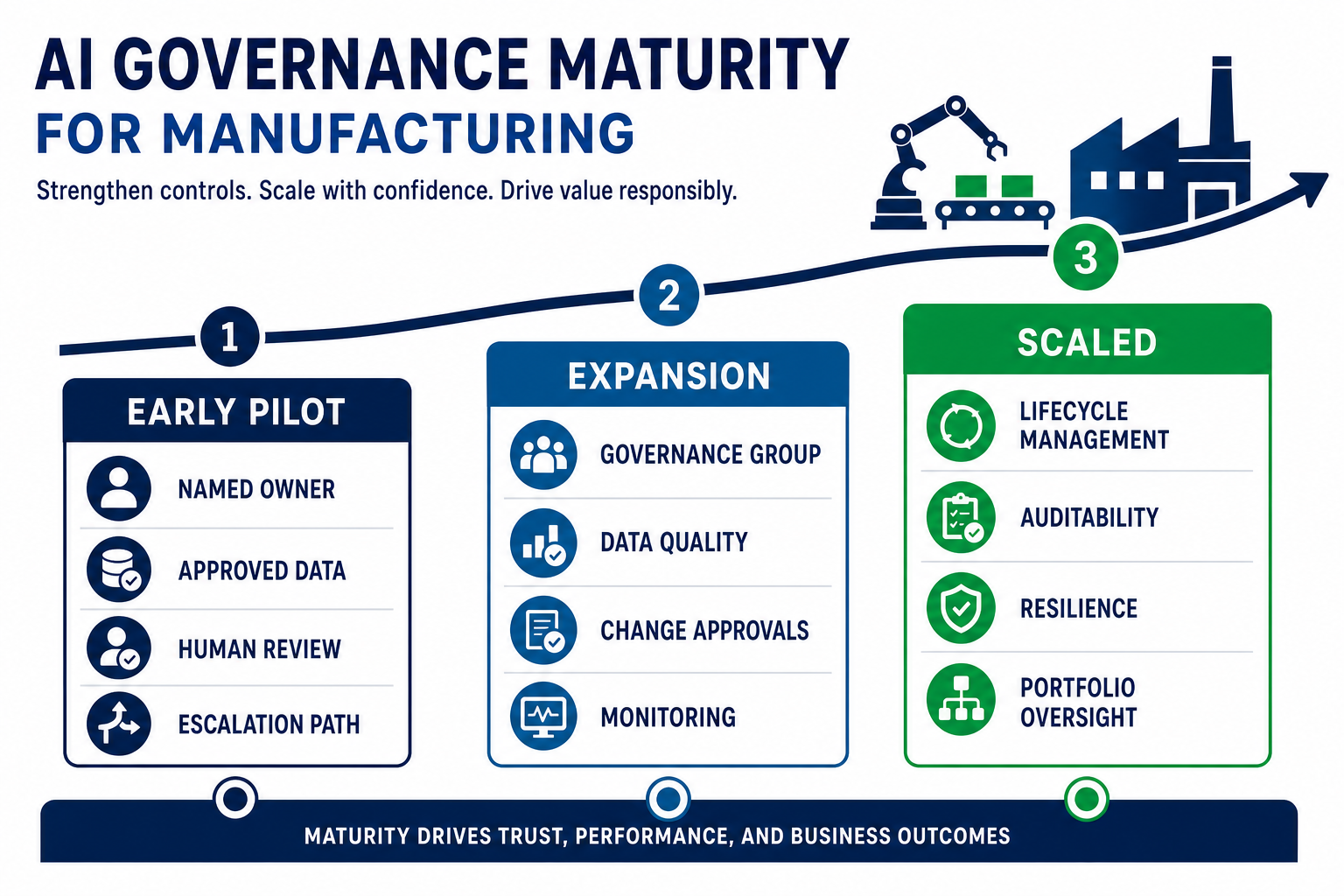
Early Pilot Governance
For an initial pilot, focus on practical controls:
- Named executive sponsor and workflow owner
- Defined purpose and success measures
- Approved data sources
- Human review before consequential actions
- Basic security and confidentiality review
- A clear escalation path for exceptions
Early Pilot Governance Checklist: Establish control before proving value
Use this checklist for a narrowly defined use case, such as purchase-order exception triage, supplier-document summarization, or a demand-forecasting decision aid. The AI should support decisions, not act without authorized human approval.
| Task | Primary owner | Completion criteria |
|---|---|---|
| Define the pilot scope | Executive sponsor and process owner | A written pilot charter identifies the workflow, user group, decision supported, expected benefit, success measures, and explicitly out-of-scope uses. |
| Assign accountable roles | Executive sponsor | An executive sponsor, process owner, technical owner, data owner, and day-to-day pilot lead are named; decision rights and escalation contacts are documented. |
| Set human-review rules | Process owner | The team knows which outputs are advisory, who reviews them, and which purchasing, inventory, production, or supplier decisions require human approval. |
| Approve data and access | Data owner with IT or security lead | Data sources, approved tool environment, access groups, storage expectations, and excluded sensitive data are documented. |
| Record risks and stop conditions | Pilot lead with process owner | A risk log covers inaccurate or stale output, supplier-data exposure, biased prioritization, and unsafe recommendations; each item has an owner, mitigation, and stop condition. |
| Capture the baseline | Process owner with analyst | The team has agreed baseline measures, target outcomes, measurement method, and review cadence before launch. |
| Enable users | Pilot lead | Users receive workflow-specific training on intended use, limitations, verification steps, and issue reporting; a short job aid is available. |
| Hold the pilot gate review | Executive sponsor and pilot group | Results, incidents, user feedback, and success criteria are reviewed; a scale, revise, pause, or stop decision is recorded. |
Early Pilot exit test: The organization can explain what the AI does and does not do, who checks its outputs, what data it uses, and whether it created a measurable benefit.
Expansion Governance
As AI expands across multiple workflows, formalize the operating model:
- A cross-functional AI governance group
- Standard use-case intake and prioritization criteria
- Data-quality ownership and remediation processes
- Model and workflow change approvals
- User training and adoption requirements
- Periodic performance and risk reviews
Expansion Governance Checklist: Make governance repeatable across workflows
Use this checklist when extending validated use cases to additional teams, facilities, suppliers, product lines, or planning workflows. The goal is to make governance repeatable rather than dependent on individual champions.
| Task | Primary owner | Completion criteria |
|---|---|---|
| Establish the governance operating model | Executive sponsor | A cross-functional group covering operations, procurement, supply chain, IT, data, security, and relevant business leaders has a documented cadence, membership, decision rights, and escalation path. |
| Standardize use-case intake | AI or transformation lead | New use cases are assessed consistently for business value, data readiness, operational risk, dependencies, and required oversight; a prioritized backlog exists. |
| Apply a reusable risk assessment | Governance lead with data owner | Each expansion to a new workflow, user group, data source, or model version has a recorded assessment, mitigation plan, and approval decision. |
| Formalize data quality and change control | Data owner | Critical sources have named owners, refresh expectations, quality checks, lineage notes, and logged approval for material changes to inputs or logic. |
| Monitor performance and drift | Process owner with technical owner | A recurring review or dashboard tracks output quality, exceptions, user overrides, operational impact, and thresholds that trigger investigation. |
| Standardize workflow controls | Technical owner with process owner | Approvals, audit trails, version identification, user-access reviews, and rollback procedures work consistently across expanded workflows. |
| Manage suppliers and third parties | Procurement lead with IT or security lead | Third-party tools, integrations, data-sharing points, support contacts, and service dependencies are inventoried with assigned owners. |
| Run role-based change management | Change lead with process owner | Affected teams receive updated procedures and training; adoption, overrides, and frontline feedback are reviewed. |
| Hold the expansion gate review | Governance group | Results and risks are compared with pilot expectations; the expand, remediate, consolidate, or retire decision is documented with owners and a next review date. |
Expansion exit test: New use cases are assessed consistently, changes are controlled, performance is monitored, and operational owners remain accountable alongside technical teams.
Scaled Governance
When AI becomes part of core planning, procurement, or supply chain decisions, governance should include ongoing monitoring, documentation, auditability, and clear accountability for outcomes.
The framework should remain practical. Its purpose is to help the organization move faster with confidence, not create a committee that slows every improvement.
Scaled Governance Checklist: Operate AI as a managed business capability
Use this checklist when AI-enabled supply-chain, procurement, and forecasting capabilities have become part of normal operating management.
| Task | Primary owner | Completion criteria |
|---|---|---|
| Formalize enterprise accountability | Executive sponsor | A governance charter, role map, delegation rules, and escalation routes define executive accountability, business ownership, technical stewardship, data ownership, and independent review where appropriate. |
| Govern the AI portfolio | AI or transformation lead | A current portfolio register tracks value delivered, risk exposure, dependencies, duplication, investment priorities, and retirement candidates on a defined cadence. |
| Manage the full lifecycle | Technical owner with governance lead | Each production use case has documented design, testing, deployment, monitoring, change, decommissioning, records-retention, owner, review date, and rollback path. |
| Test operational resilience | Operations leader with IT | Critical workflows have tested manual fallbacks and recovery procedures for unavailable tools, failed integrations, poor data feeds, or degraded output. |
| Conduct ongoing assurance | Governance lead | Periodic access, data-quality, output-quality, incident, control, and business-outcome reviews are logged, assigned, tracked to closure, and reported to leadership. |
| Maintain decision-quality controls | Process owner | A current decision-authority matrix defines where AI may recommend, rank, summarize, or automate; human-review thresholds match operational impact and are evidenced in practice. |
| Measure realized value and risk together | Finance or business performance lead with process owner | Leadership receives regular reporting that distinguishes realized benefits from projected benefits and includes errors, rework, adoption, service levels, inventory effects, and user confidence. |
| Learn from incidents and near misses | Governance lead | A single reporting route captures errors, unexpected outcomes, data issues, and near misses; severity levels, response owners, corrective actions, and lessons are recorded. |
| Maintain workforce capability | Learning lead with process owners | Role-based training and competency checks are maintained for users, approvers, technical teams, and leaders, and refreshed as workflows or tools change. |
| Reassess, improve, or retire use cases | Portfolio owner with executive sponsor | Material use cases have recorded continue, improve, replace, consolidate, or retire decisions based on value, safety, maintainability, and business alignment. |
Scaled-stage exit test: Governance is part of normal operating management: accountability is clear, critical workflows have fallbacks, performance and risk are reviewed together, and the organization can improve or retire systems deliberately.
Downloadable Governance Checklist Template
For a downloadable worksheet, add the following fields to every checklist row:
| Field | Use |
|---|---|
| Status | Not started, in progress, blocked, complete, or not applicable |
| Accountable owner | The person ultimately answerable for completion |
| Contributors | Teams or roles supporting the work |
| Evidence link or location | Pilot charter, risk log, approval record, training record, dashboard, or procedure |
| Target date | Planned completion date |
| Review date | Next governance review point |
| Notes and blockers | Dependencies, exceptions, open decisions, or remediation needs |
This is a practical governance checklist, not legal or regulatory advice. Tailor approval thresholds, retention rules, security controls, and escalation paths to your organization, data environment, contractual obligations, and applicable requirements.
Common Mistakes to Avoid
Starting With Technology Instead of a Workflow
A tool-first approach often produces demonstrations without operational adoption. Begin with a decision, a bottleneck, and a measurable consequence.
Trying to Automate High-Consequence Decisions Too Early
Early use cases should support people with visibility and prioritization. Keep human judgment in the loop while the organization learns.
Ignoring Data Ownership
AI cannot compensate indefinitely for unclear definitions, missing fields, late updates, or conflicting sources of truth.
Treating Governance as a Post-Pilot Task
Governance is most useful when it shapes the pilot: approved data, clear roles, review requirements, escalation paths, and feedback loops.
Measuring Only Technical Performance
A model may perform well in testing and still fail to improve the workflow. Measure operational outcomes, user adoption, decision quality, and process impact.
Conclusion: Start With the Workflow, Then Scale With Confidence
For mid-sized manufacturers, the most valuable AI initiatives rarely begin with a broad technology rollout. They begin with a specific operational decision that is slow, inconsistent, or difficult to make with the information already available.
That is why supply chain visibility, procurement prioritization, and demand forecasting are practical places to start. Each can expose a measurable problem, establish a baseline, and create a focused pilot before AI is introduced more widely across the business.
The goal is not to automate every decision. It is to help buyers, planners, supply chain leaders, and operations teams see meaningful signals earlier, focus on the exceptions that matter, and make more informed decisions with clear accountability.
At WSI AI Advisors, we help organizations move from AI interest to a practical adoption path: assessing readiness, identifying high-value use cases, building a roadmap, preparing governance, supporting implementation, and strengthening team adoption. Our approach starts with the workflow and the business outcome—not the technology alone.
If you are evaluating where AI could create practical value in your manufacturing operations, WSI AI Advisors can help you identify bottlenecks, prioritize realistic use cases, and define a measured path from pilot to scale.
Related Resources
About the Author
The Best Digital Marketing Insight and Advice
The WSI Digital Marketing Blog is your go-to-place to get tips, tricks and best practices on all things digital
marketing related. Check out our latest posts.
Ready to turn AI insight into a practical business plan?
Speak with an AI ConsultantWe are committed to protecting your privacy. For more info, please review our Privacy and Cookie Policies. You may unsubscribe at any time.
Don't stop the learning now!

When AI Outgrows Your Team: How to Close the Capability Gap
AI Strategy & Organizational Readiness How to Close the Capability Gap AI initiatives often begin with a few motivated employees testing tools and discovering faster ways to work. But as those experiments become more valuable, they also become more complex. The real question is whether your organization has the strategy, expertise, governance, and capacity required …
Continue reading “When AI Outgrows Your Team: How to Close the Capability Gap”
READ MORE
When AI Outgrows Your Team: How to Close the Capability Gap
AI Strategy & Organizational Readiness When AI Outgrows Your Team: How to Close the Capability Gap AI initiatives often begin with a few motivated employees testing tools and discovering faster ways to work. But as those experiments become more valuable, they also become more complicated. The challenge is no longer simply learning how to use …
Continue reading “When AI Outgrows Your Team: How to Close the Capability Gap”
READ MORE
Who Checks the AI? Building Accountability Into AI-Powered Work
AI Governance & Risk Can You Trust AI at Work? A Risk-Based Review Framework for Business Leaders AI can make work faster, but speed alone does not make a workflow dependable. A practical review system helps organizations decide what needs a quick check, what requires expert oversight, who owns the final decision, and whether AI …
Continue reading “Who Checks the AI? Building Accountability Into AI-Powered Work”
READ MORE