604.506.5068
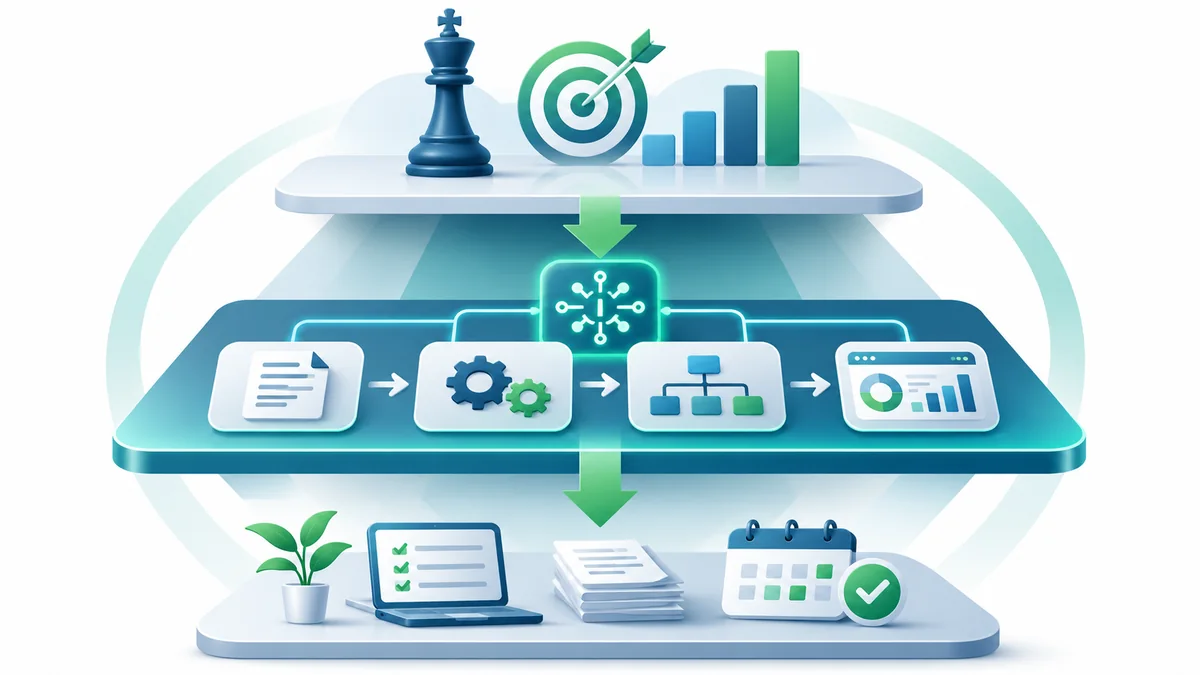
Many organizations now have an AI strategy. Leaders have identified potential use cases, employees have experimented with new tools, and teams may have completed their first training sessions. Yet the real test begins after the presentation ends: Who makes AI part of the way work actually gets done?
Between executive direction and individual tool use sits a critical operational layer. Team managers, process owners, supervisors, and experienced employees interpret broad priorities, redesign specific tasks, set quality expectations, and help colleagues use AI appropriately.
This is the middle layer of AI adoption. It is often overlooked, even though it determines whether promising initiatives become reliable business practices or remain isolated experiments.
An AI strategy creates direction. The middle layer turns that direction into a process people can follow, review, and improve.
What Leadership Approval Leaves Undecided
Leadership can approve an AI initiative, select a platform, and define a productivity target. Those decisions matter, but they do not tell employees what to do when a customer request is incomplete, a generated answer appears incorrect, or a task requires sensitive company information.
Without operational guidance, departments make their own assumptions. One employee might accept an AI draft immediately while another rewrites it from scratch. A third may avoid the tool entirely because the expected review process is unclear.
The result is uneven adoption. The organization may report strong interest in AI, yet still struggle to produce consistent outcomes.
Closing this gap requires answers to four practical questions:
- When: At which step in an established workflow should AI be used?
- How: What information, instructions, tools, and standards are approved?
- Who: Who performs the task, reviews the output, and makes the final decision?
- What if: What happens when the output is uncertain, incorrect, or outside the approved use case?
Who Turns AI Strategy Into Practical Team Guidance?
The work usually belongs to several people rather than a single AI champion. In a small organization, one manager may cover multiple responsibilities. In a larger company, ownership is often shared across business operations, information technology, risk, and training.
| Role | Contribution to daily AI adoption |
|---|---|
| Executive sponsor | Defines the business outcome, approves resources, and removes organizational barriers. |
| Process owner | Maps the actual workflow and decides where AI supports—or should not replace—existing steps. |
| Team manager | Sets everyday expectations, coordinates coaching, and checks whether the process is being followed. |
| Technology and risk partners | Confirm permitted tools, data handling, access, security controls, and escalation requirements. |
| Employees and reviewers | Perform the work, validate outputs, flag failures, and identify opportunities to improve the process. |
The most important point is not the job title. It is that somebody owns the transition from an approved idea to a repeatable way of working. When accountability is left implicit, AI adoption becomes dependent on personal initiative rather than an operating model.
What Stops Teams From Using AI Consistently?
Employee hesitation is sometimes framed as resistance to change. In practice, the barriers can be more concrete. People may not know which tasks are suitable for AI, what they are allowed to share, how to check results, or whether the new method will be evaluated fairly.
Common causes of inconsistent adoption include:
- Vague use cases: “Use AI to be more productive” is not a workflow instruction.
- Missing review standards: Teams do not share a definition of acceptable output quality.
- Unclear data rules: Employees are unsure whether customer or internal information may be entered into a tool.
- No time to learn: Training happens separately from real workloads, with little opportunity to practice.
- No escalation path: A failed result leaves the employee guessing what to do next.
- Misleading metrics: Tool logins are counted, but the quality and completion of work are not assessed.
The answer is not necessarily another general training session. Often the organization needs clearer task-level instructions, realistic practice, and a person responsible for follow-through.
Example: Turning an AI Experiment Into a Recurring Reporting Process
Imagine a department that prepares a weekly operational summary. An employee discovers that an AI assistant can draft the narrative quickly. The pilot looks promising, so leadership encourages the whole team to use it.
But a repeatable process requires more than a saved prompt. The team must agree on which data sources are approved, how figures are validated, who reviews commentary, and when the report can be sent to decision-makers.
| Without operational guidance | With a defined AI-assisted workflow |
|---|---|
| Each employee chooses their own input data. | The team uses approved reports and checks that data is current. |
| Prompts and output formats vary. | A documented template establishes consistent structure and expectations. |
| Drafts may be sent without a clear review. | A named reviewer verifies figures, claims, and exceptions. |
| Errors are fixed individually and forgotten. | Recurring issues are recorded and used to improve instructions. |
| Success is defined as faster drafting. | Success includes total completion time, correction rate, and usefulness to managers. |
This operational design does not eliminate human judgment. It gives employees a clearer way to apply judgment consistently, while making the outcome easier to measure and improve.
Five Steps to Make AI Part of Daily Work
1. Choose One Workflow That Should Improve
Select a recurring task with an identifiable owner, a clear starting point, and a defined output. Favor a process where the team can observe results and compare them against the current way of working.
2. Decide What AI Can and Cannot Do
Separate tasks suitable for assistance—such as organizing information or drafting internal summaries—from steps that require qualified human review or approval. Document permitted tools, data sources, and sensitive-information restrictions.
3. Describe the Expected Output and Review Standard
Specify what an acceptable result looks like. Include formatting requirements, fact-checking expectations, common failure modes, and circumstances where the process should stop and escalate to a person.
4. Assign Coaching and Approval Responsibilities
Identify the process owner and the reviewer, and give employees time to practice on realistic examples. Team managers should be able to answer routine questions or direct staff to somebody who can.
5. Improve the Process After Real Use
Review a sample of completed work, capture exceptions, and adjust the guidance. If the team cannot follow the process consistently, resolve those problems before expanding it across departments.
Measure What Changes in the Workflow
AI adoption cannot be evaluated solely by the number of accounts activated or employees trained. Those indicators may show initial participation, but they do not confirm sustained business value.
A stronger review measures the complete task, including the work that happens before and after an AI response:
- Completion time: How long does the full process take, including review and corrections?
- Output quality: Does the finished work meet an agreed standard?
- Rework: How often does an employee need to correct or redo the result?
- Consistency: Can other trained employees achieve comparable outcomes?
- Escalations: Are unusual cases identified and resolved appropriately?
- Business effect: Does the change improve capacity, customer experience, speed, or another defined objective?
Measure the baseline before the workflow changes where possible. Then review results regularly, including costs and risks. A process that drafts faster but creates more downstream corrections may not deliver the improvement leaders expected.
Put AI to Work Across Teams With WSI AI Advisors
The operational middle layer is where business strategy becomes everyday behavior. It requires a combination of use case selection, process design, training, ownership, and governance.
WSI AI Advisors works with organizations to connect AI opportunities to actual business priorities. Depending on a team’s needs, this can involve clarifying use cases, developing an AI roadmap, preparing employees for adoption, and planning implementation around measurable outcomes.
For leaders, a useful starting question is not “How many people are using AI?” It is “Which business process now works better because we introduced AI, and who is responsible for keeping it that way?”
Frequently Asked Questions About Operational AI Adoption
Who should own AI adoption in a company?
Executive leadership should sponsor the initiative, but day-to-day adoption typically needs a designated business or process owner. Team managers, technology partners, and reviewers share responsibility for making the workflow practical, safe, and consistent.
Why isn’t AI training enough to change everyday work?
General training can improve awareness and skills, but employees still need task-specific instructions, approved tools, clear review criteria, practice opportunities, and ongoing support to apply those skills reliably.
What is the middle layer of AI adoption?
It refers to the operational roles and activities that translate executive AI priorities into usable workflows. This includes assigning responsibilities, documenting procedures, setting standards, coaching teams, and improving performance.
How can a small business build an AI adoption process?
Start with one repeatable task. Name its owner, establish permitted inputs and tools, create a simple review checklist, train the employees involved, and compare completed results with the existing process before expanding.
How do businesses know whether AI is being adopted successfully?
Look for improved results in completed workflows: suitable quality, less unnecessary rework, dependable turnaround times, consistent execution across employees, and measurable value relative to the full cost of the process.
The Missing Link Between AI Strategy and Results
AI initiatives succeed in daily operations when employees know what is expected, managers know what to review, and the business knows how to measure progress. Strategy and technology are essential, but neither replaces operational ownership.
The next practical step is to choose one workflow and make its responsibilities, standards, safeguards, and business outcome explicit. That is how AI moves from an interesting tool to a dependable part of work.
The real measure of AI adoption is not how often people open a tool. It is whether the organization can complete important work more effectively, consistently, and responsibly.